
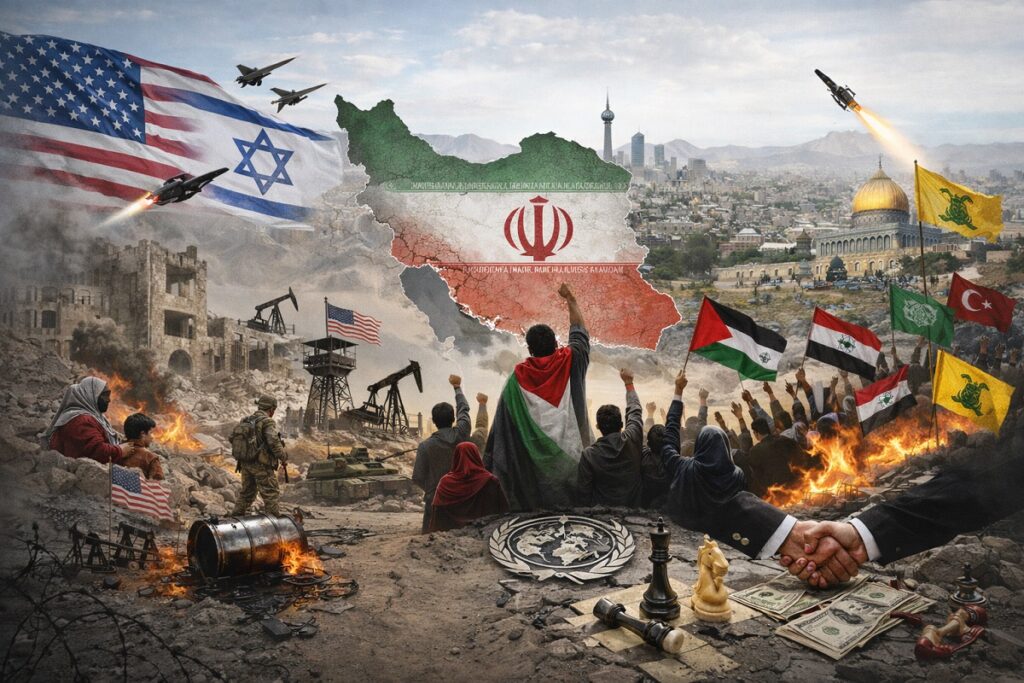
Leading international law scholars and United Nations experts are raising serious questions about the legality of recent United States and Israeli military strikes against Iran, warning that the attacks likely violate the prohibition on the use of force enshrined in the United Nations Charter.
The strikes, which have escalated into a broader regional conflict, were carried out without authorization from the United Nations Security Council and absent a prior armed attack by Iran against either the US or Israel, legal analysts say.
Allegations of Crime of Aggression
Ben Saul, the UN special rapporteur on the promotion and protection of human rights while countering terrorism, described the strikes as unlawful.
“This is not lawful self-defence against an armed attack by Iran, and the UN Security Council has not authorized it,” Saul said in comments to Al Jazeera, adding that preventive disarmament or regime change operations may constitute the international crime of aggression.
Under Article 2(4) of the UN Charter, member states are prohibited from using force against the territorial integrity or political independence of another state, except in narrowly defined circumstances.
Yusra Suedi, assistant professor of international law at the University of Manchester, said there are credible grounds to view the attacks as an unjustified use of force.
“This was an act of use of force that was unjustified,” Suedi said, noting that international law permits force only when authorized by the Security Council or exercised in self-defence against an armed attack.
Imminence and Self-Defence
The administration of US President Donald Trump has argued that Iran’s missile and nuclear programmes posed an imminent threat, making military action necessary to defend American lives.
However, Rebecca Ingber, a professor at Cardozo School of Law at Yeshiva University and former legal adviser to the US State Department, emphasized that the prohibition on the use of force is a “bedrock” principle of international law.
“States may not use force against the territorial integrity of other states except in two narrow circumstances — when authorised by the UN Security Council or in self-defence against an armed attack,” Ingber said.
Suedi questioned whether the threshold for imminence had been met. Under established legal standards, she explained, an imminent threat must be “instant, overwhelming, and leaving no choice of means.”
“There really was no evidence of an imminent threat,” Suedi said, characterizing the action as a pre-emptive strike — a doctrine widely viewed as unlawful under international law when not tied to immediate danger.
Humanitarian Law Concerns
Beyond the jus ad bellum question of whether the war itself is lawful, experts warn that aspects of the strikes may also breach international humanitarian law.
Reports indicate that an attack on a girls’ school in the southern Iranian city of Minab killed at least 165 people. If verified, such an incident could raise serious concerns under the laws of armed conflict, which require distinction between civilian and military targets and proportionality in the use of force.
Annie Shiel, US director at the Center for Civilians in Conflict, described the reported strikes on schools and civilian infrastructure as “deeply alarming,” warning of devastating consequences for children and other noncombatants.
“In the context of war, from the moment that the first strike was launched, the rules of warfare apply,” Suedi said. “Civilian objects and spaces cannot be targeted.”
Iran’s retaliatory missile and drone strikes on regional military installations and civilian sites — including airports, hotels and energy facilities — have also drawn scrutiny. Suedi said those actions may likewise violate international law if civilian targets were intentionally struck.
Broader Erosion of Legal Norms
The legal controversy surrounding the Iran strikes unfolds against what many scholars describe as a broader weakening of international legal constraints on state conduct.
Suedi pointed to Russia’s invasion of Ukraine and Israel’s military campaign in Gaza as examples of mounting strain on the post–World War II legal order.
Ingber warned that normalization of expansive self-defence claims risks eroding the fragile system designed to prevent interstate war.
“The prohibition on the use of force is a relatively recent innovation,” she said. “This rule is policed through the actions and reactions of states, and it feels fragile right now.”
As hostilities continue and diplomatic efforts stall, the unfolding conflict may test the resilience of the international legal framework — and determine whether the prohibition on aggressive war remains enforceable in practice or increasingly symbolic in principle.