
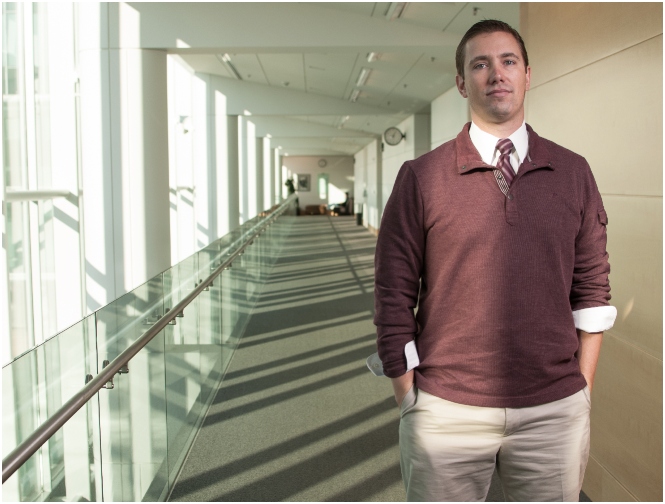
In what legal scholars are calling one of the most remarkable redemption stories in modern American jurisprudence, a convicted bank robber who taught himself law while serving a 12-year federal prison sentence has become a professor at one of the nation’s premier law schools.
Shon Hopwood, now a professor at Georgetown University Law Center, first gained attention as a “jailhouse lawyer” at the Federal Correctional Institution in Pekin, Illinois, where he successfully petitioned the U.S. Supreme Court on behalf of a fellow inmate—a feat that eludes even the most accomplished appellate attorneys .
From Nebraska Farm to Federal Prison
Hopwood, 42, grew up in the small farming community of David City, Nebraska. A bright but rebellious student, he won a basketball scholarship to Midland University but partied his way out within a semester. After a stint in the Navy, he returned to Nebraska, broke and frustrated, working in a feedlot .
In 1998, at age 23, Hopwood agreed to a friend’s suggestion to rob small-town banks.
“It sounded exciting,” he later told 60 Minutes. “Sounded like easy money.”
He committed five bank robberies, stealing approximately $150,000, and was apprehended by the FBI in an Omaha hotel in July 1998. He pleaded guilty to armed bank robbery and was sentenced to 12 years and three months in federal prison .
The Jailhouse Lawyer
At FCI Pekin, Hopwood landed a job in the prison law library. Initially intimidated by the “big, thick” legal volumes, he eventually found his calling. “I would be sitting in my cell reading a federal reporter… cover to cover as if it was a novel,” he recalled. “The law is fascinating. It was like a big puzzle for me” .
In 2003, a fellow inmate asked Hopwood to prepare a petition for certiorari to the U.S. Supreme Court in the case of Fellers v. United States. Despite initial reluctance, Hopwood spent months mastering the facts, statutes, and precedents. The Supreme Court granted the petition—one of only 74 accepted that year out of more than 8,000 filed.
The case was argued by Seth Waxman, a former U.S. Solicitor General, who insisted Hopwood remain part of the legal team. “It seemed actually almost inconceivable that somebody with his level of education… could actually write a much better than average cert petition,” Waxman said. The Court ruled unanimously in Fellers’ favor.
Hopwood went on to win another Supreme Court case and multiple appeals in lower courts, establishing himself as one of the most successful jailhouse lawyers in American history.
The Road to Redemption
After his release in 2009, Hopwood faced skepticism from lawyers who told him he would never be admitted to any state bar. But with Waxman’s mentorship and support from the legal community, he earned his undergraduate degree from Bellevue University, then a Juris Doctor from the University of Washington School of Law as a Gates Public Service Law Scholar. He clerked for Judge Janice Rogers Brown on the U.S. Court of Appeals for the D.C. Circuit—the second most important court in the country—and was admitted to the Washington State Bar in 2015.
In 2017, Georgetown Law appointed Hopwood a professor.
“There are days where it doesn’t make sense to me, and I’ve lived it,” he told 60 Minutes. “I can see why it doesn’t make sense to hardly anyone else.”
Criminal Justice Reform Advocate
Hopwood now advocates for shorter prison sentences and increased vocational training, drug treatment, and mental health counseling in prisons. “Prison is not the place for personal growth,” he said. “We warehouse people and then we kick them out into the real world with very little support and hope that a miracle happens” .
His story raises profound questions about the purpose of incarceration and the potential for rehabilitation. As the federal judge who sentenced him, Richard G. Kopf, later wrote, “Hopwood proves that my sentencing instincts suck.”