
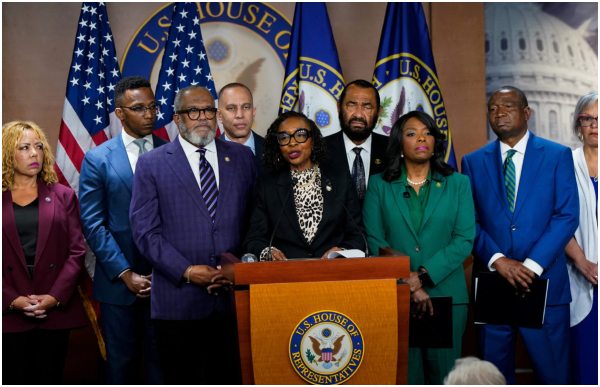
The Congressional Black Caucus (CBC) has launched a new effort to enlist corporate America in the escalating legal and political fight over congressional redistricting, sending letters to more than 250 companies urging them to oppose map-drawing initiatives that lawmakers say threaten Black political representation.
The campaign comes amid renewed scrutiny of voting rights protections following a recent U.S. Supreme Court decision that significantly weakened a key provision of the Voting Rights Act, prompting concerns among civil rights advocates that states may redraw congressional boundaries in ways that dilute minority voting strength.
Attorney and legal commentator Danielle Bess argues that the CBC’s strategy could have meaningful influence, not necessarily through litigation, but through economic leverage.
“The Congressional Black Caucus just sent a letter to 250 corporations in the United States asking them to support Black voting rights,” Bess said in a recent social media analysis. “I think it will [have an impact], and let me explain why.”
According to reporting by PBS, the caucus has called on corporations that previously supported voting-rights initiatives and racial-equity commitments to publicly oppose efforts to eliminate majority-Black congressional districts. The lawmakers contend that recent redistricting actions in several Republican-led states could diminish Black electoral representation and undermine protections historically associated with the Voting Rights Act.
The CBC’s letter asks companies to condemn redistricting plans that allegedly dilute minority voting power, engage directly with caucus members regarding voting-rights protections, and disclose political contributions to officials involved in redistricting efforts.
Representative Yvette Clarke, chair of the CBC, described the initiative as “putting corporate America on notice,” while emphasizing that the caucus is seeking partnership rather than confrontation.
Economic Leverage as a Civil Rights Strategy
Bess framed the CBC’s approach through the concept of strategic leverage, drawing a comparison to the geopolitical significance of the Strait of Hormuz.
While acknowledging that Iran accounts for a relatively small share of global oil production, Bess noted that its geographic position gives it disproportionate influence over international energy markets.
“The lesson,” she said, “is that you don’t have to be the biggest power in the room. You have to control the chokepoint.”
Applying that principle domestically, Bess argued that Black consumers and workers represent a significant economic constituency whose influence corporations cannot easily ignore.
“Black consumers, culture, and workers are a choke point that corporations depend on,” she said. “So corporate economic pressure that can be placed on red states and places where they are redistricting can be significant.”
Voting Rights Litigation and Corporate Responsibility
The CBC’s initiative arrives as legal challenges to congressional maps continue in multiple jurisdictions. Voting-rights advocates have increasingly relied on litigation under the Voting Rights Act, the Fourteenth Amendment, and the Fifteenth Amendment to challenge district maps alleged to dilute minority voting strength.
However, recent Supreme Court rulings have altered the legal landscape, leading some civil rights organizations to pursue parallel strategies that combine litigation, public advocacy, and economic pressure.
The caucus’s letter references prior commitments made by many corporations following the 2020 racial justice protests and subsequent efforts to strengthen voting-rights protections. Lawmakers argue that corporations that publicly endorsed democratic participation and racial equity should maintain those positions when electoral representation is at stake.
The effort also raises broader questions about the role of private-sector actors in constitutional and civil-rights disputes. While corporations have historically weighed in on issues ranging from voting access to LGBTQ+ rights and immigration policy, legal scholars continue to debate the extent to which corporate advocacy should influence state policymaking.
A New Front in the Redistricting Debate
Bess suggested that the success of the CBC’s campaign may ultimately depend less on whether corporations support voting rights as a matter of principle and more on whether they perceive economic risks associated with remaining silent.
“People who say these corporations probably don’t care about voting rights are probably correct,” she said. “But they don’t have to care. They just need to know that they can feel economic pain in order for them to act.”
As redistricting disputes move through courts and legislatures nationwide, the CBC’s outreach effort represents an attempt to expand the battle beyond the courtroom, leveraging economic influence to shape outcomes in a legal fight that could determine the future of Black political representation for years to come.
This version is structured more like a legal affairs article, emphasizing constitutional issues, Voting Rights Act implications, redistricting litigation, and the intersection of corporate influence and civil-rights law.