
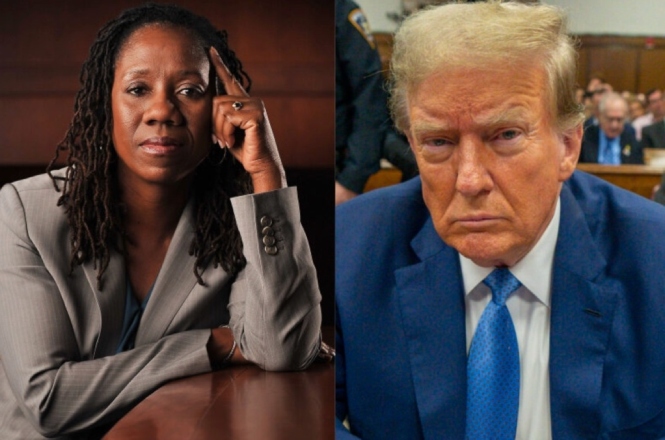
A rare courtroom appearance by President Donald Trump during oral arguments at the U.S. Supreme Court has drawn sharp legal commentary, with civil rights attorney Sherrilyn Ifill pointing the limits of political influence inside the nation’s highest court.
“There are just places in which he is very small,” Ifill said, reflecting on Trump’s presence during proceedings. “And the Supreme Court… has its own choreography.”
A Constitutional Clash Over Birthright Citizenship
The remarks came after oral arguments in what Ifill described as “one of the most consequential cases in years” — a legal challenge to an executive order issued by Trump seeking to restrict birthright citizenship under the 14th Amendment.
The case centers on the constitutional guarantee that individuals born in the United States are citizens, a principle long interpreted through the Citizenship Clause of the 14th Amendment.
Legal scholars widely view the dispute as a direct test of established precedent, including interpretations stemming from United States v. Wong Kim Ark (1898), which affirmed birthright citizenship.
Courtroom Dynamics and Presidential Presence
Trump’s attendance at the hearing was notable but, according to Ifill, legally and procedurally insignificant.
“He sat discreetly in the back,” she noted, emphasizing that the courtroom’s structure and norms remained intact.
“I think it was a good lesson for him,” Ifill added. “The Supreme Court… has an atmosphere that has been set for a very long time.”
She stressed that the presence of a former president did not alter the tone, proceedings, or judicial engagement during arguments — reinforcing the institutional independence of the Court.
Advocacy and Legal Performance Under Scrutiny
Ifill also highlighted the performance of counsel representing the challengers, particularly praising the American Civil Liberties Union’s advocacy.
“I’ve rarely heard a better argument in the United States Supreme Court,” she said, pointing to clarity, responsiveness, and command of constitutional law as defining features of the presentation.
She suggested the legal arguments presented by the plaintiffs — challenging the executive order — were sufficiently strong to prevail, though she acknowledged the unpredictability of Supreme Court rulings.
“With this Supreme Court, it’s always hard to tell,” Ifill cautioned.
Legal Implications and What Comes Next
The case carries significant constitutional implications, particularly regarding executive authority and the scope of the 14th Amendment.
A ruling in favor of the executive order could fundamentally alter longstanding interpretations of citizenship law, while a decision against it would reaffirm judicial precedent limiting presidential power in this domain.
A decision is expected later this year.
Institutional Independence in Focus
Ifill’s remarks ultimately point to a broader legal principle: the autonomy of the judiciary.
Even in the presence of powerful political figures, she suggested, the Supreme Court operates within a defined procedural and constitutional framework that resists external influence.
“There were no shenanigans,” she said. “It didn’t change the environment at all.”
As the nation awaits the Court’s decision, the case stands as a critical moment in constitutional law — testing not only the boundaries of citizenship, but also the resilience of judicial independence.