
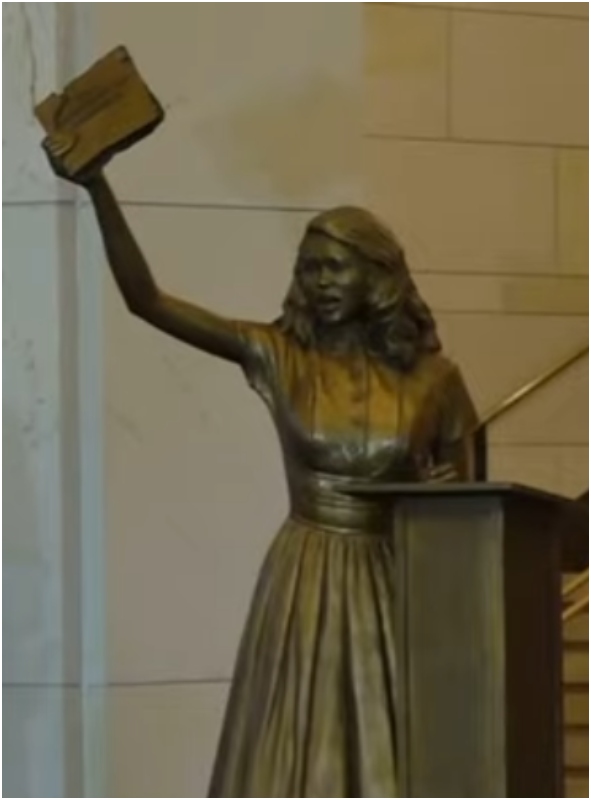
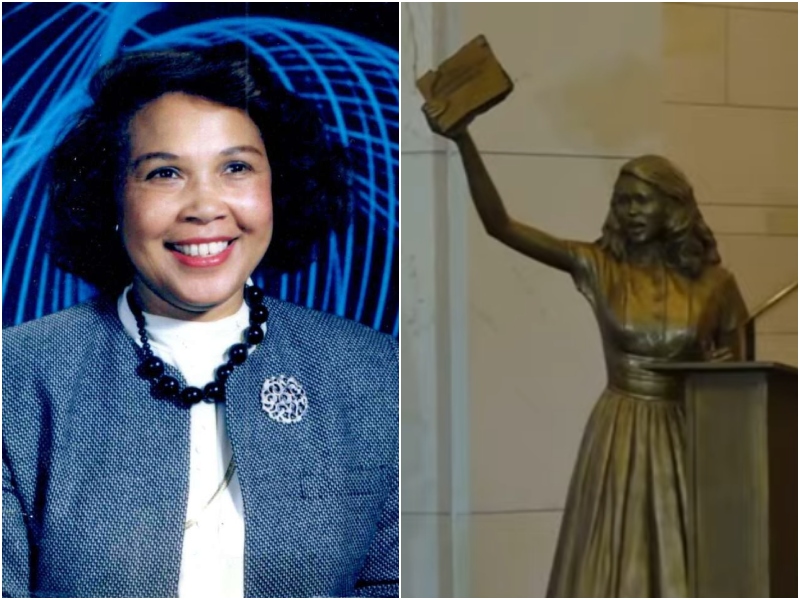
The U.S. Capitol unveiled a new statue of civil rights pioneer Barbara Rose Johns on Tuesday, December 16, 2025, marking a historic replacement for the statue of Confederate General Robert E. Lee. The 11-foot bronze figure now represents Virginia in the National Statuary Hall Collection.
Johns, at age 16, organized a landmark student strike in 1951 at Virginia’s segregated Robert Russa Moton High School. The protest targeted overcrowded classrooms and inferior educational facilities for Black students. Her leadership prompted the NAACP to file a lawsuit that ultimately became part of Brown v. Board of Education (1954), the Supreme Court decision that declared segregated public schools unconstitutional and overturned the “separate but equal” doctrine.
Sculpted by Maryland artist Steven Weitzman, the statue depicts Johns standing at a podium holding a tattered book above her head. Its pedestal bears her words: “Are we going to just accept these conditions, or are we going to do something about it?” and a quote from the Book of Isaiah: “And a little child shall lead them.”
The ceremony at Emancipation Hall included Virginia’s congressional delegation, House Speaker Mike Johnson (R), Minority Leader Hakeem Jeffries (D), Governor Glenn Youngkin (R), and Governor-elect Abigail Spanberger (D). Johnson highlighted Johns’ role as “one of America’s true trailblazers, a woman who embodied the essence of the American spirit in her fight for liberty, justice, and equal treatment under the law.”
The Lee statue, which had represented Virginia in the Capitol for 111 years, was removed in December 2020 following renewed national attention on Confederate monuments after George Floyd’s death. It is now housed at the Virginia Museum of History & Culture.
Barbara Rose Johns’ legacy is a defining moment in civil rights legal history, illustrating how grassroots activism by minors can catalyze landmark litigation.
Her actions remain a case study in the intersection of education, civil rights law, and constitutional jurisprudence.
The Moton High School where she led the protest is now a National Historic Landmark and museum, commemorating her pivotal role in ending school segregation in the United States.