
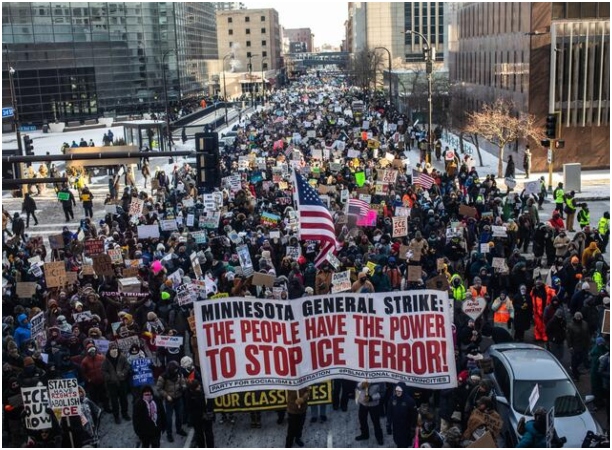
A sweeping, citywide strike and mass protest against U.S. Immigration and Customs Enforcement (ICE) in Minnesota has triggered renewed legal scrutiny of federal immigration enforcement practices, labor protections, and constitutional rights, following what organizers describe as one of the largest acts of civil resistance in the state’s modern history.
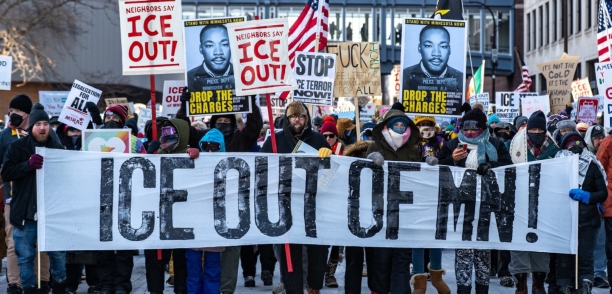
More than 50,000 demonstrators flooded downtown Minneapolis on January 23, 2026, braving temperatures as low as –20°F, in an action dubbed “ICE Out of Minnesota: Day of Truth and Freedom.” The mobilization—documented by Labor Notes reporters Diana Varenik and Luis Feliz Leon—combined mass protests, coordinated work stoppages, and civil disobedience across the Twin Cities.
At the heart of the action were demands with direct legal implications: the removal of ICE from the metropolitan area, the criminal prosecution of a federal agent involved in the killing of legal observer Renee Nicole Good, and a call for Congress to reject additional ICE funding.
Federal Enforcement Under Legal Fire
The strike followed weeks of escalating confrontations between federal agents and Minnesota residents. According to organizers, ICE has arrested an estimated 3,000 people in recent operations, during which three individuals were shot and two U.S. citizens—Renee Good and Alex Pretti—were killed. Pretti, an intensive-care nurse and union member, was fatally shot a day after the mass march.
Civil rights advocates argue that these incidents raise serious questions about use of lethal force, due process, and Fourth Amendment protections, particularly amid allegations that ICE agents have conducted warrantless home entries, racial profiling, and citizen detentions.
One Department of Homeland Security official dismissed the strike as “beyond insane,” defending ICE’s actions as public safety enforcement. However, legal observers note that the deaths of U.S. citizens during immigration operations could expose the federal government to constitutional litigation, wrongful death claims, and criminal investigations.
Labor Law, No-Strike Clauses, and Protected Workarounds
From a labor law perspective, the January 23 action was notable for how unions navigated no-strike clauses and other contractual restrictions. Multiple unions—including SEIU, UNITE HERE, CWA, UFCW, AFSCME, AFT, and teachers’ unions—used legally permissible mechanisms such as earned sick leave, personal days, safety concerns, and school closures to enable mass participation without triggering immediate retaliation.
Minnesota’s Earned Sick and Safe Time law, which mandates paid leave for illness, safety, and caregiving needs, provided a critical legal shield. Union leaders said this framework allowed thousands of workers to withhold labor while remaining within statutory protections.
Education law also came into focus as thousands of teachers called in sick, overwhelming substitute systems and forcing district closures. While districts cited extreme cold, union leaders framed the action as a moral stand reminiscent of historic—often illegal—teacher strikes that later reshaped labor law in the United States.
Airports, Arrests, and Due Process Concerns
Legal tensions were especially visible at Minneapolis–Saint Paul International Airport (MSP), where clergy-led civil disobedience targeted airlines accused of facilitating deportation flights. Roughly 100 clergy members were arrested after blocking access roads, raising questions about First Amendment protections, airport security regulations, and the scope of lawful protest on federal transportation property.
Flight attendants and airport workers reported troubling encounters with Department of Homeland Security agents, including alleged attempts to pressure airline staff to assist in identifying or removing passengers—some of whom were U.S. citizens. Aviation labor advocates warn that such incidents may implicate employment law, retaliation protections, and passenger civil rights, particularly if airline staff are coerced into enforcement roles without clear legal guidance.
Chilling Effects on Communities and Organizing
Testimonies from workers, teachers, and drivers described widespread fear affecting daily life—children kept home from school, immigrant-owned businesses shuttered, and entire neighborhoods disrupted by reports of door-to-door ICE operations. Organizers argue that these conditions amount to a chilling effect on freedom of movement, education access, and economic participation, with potential ramifications under civil rights law.
At the same time, union leaders report a surge in organizing activity, as fear has galvanized workers to seek collective legal protection. One SEIU-affiliated driver noted that a previously small organizing committee has grown to 3,000 members, underscoring how aggressive enforcement can unintentionally strengthen labor mobilization.
A Defining Legal Moment
Legal scholars and labor advocates say the Minnesota strike may become a defining case study in how mass protest, labor law, and federal immigration authority intersect. Comparisons have already been drawn to the 1934 Minneapolis General Strike and the 2006 “Day Without Immigrants”, both of which reshaped legal and political debates nationwide.
As investigations into the shootings continue and unions weigh further actions, courts may soon be asked to determine whether federal immigration enforcement in Minnesota crossed constitutional lines—and whether workers’ coordinated resistance represents protected collective action or an unlawful shutdown.
For now, the Twin Cities remain a focal point in a growing national legal reckoning over immigration enforcement, state power, and the rights of workers and citizens alike.