
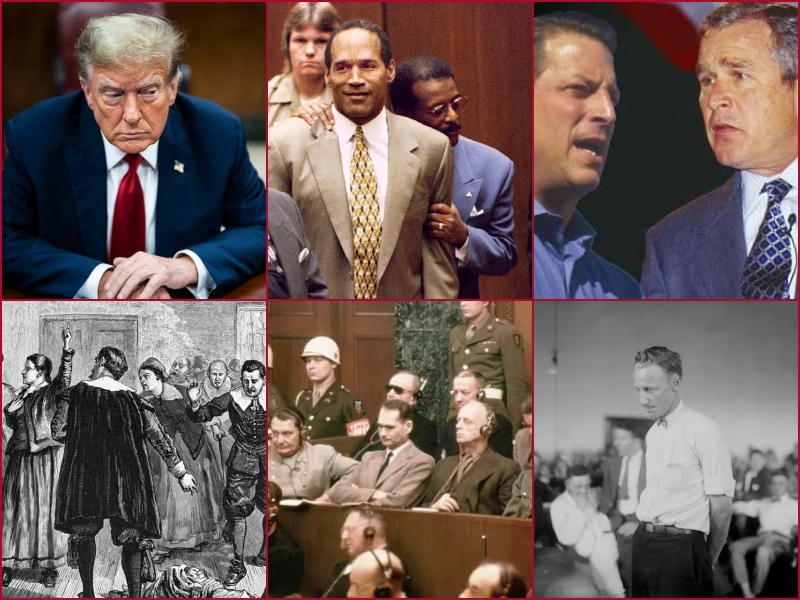
American courtrooms have produced some of the most dramatic, bizarre, and culturally defining moments in the nation’s history.
Here are seven of the wildest, blending jaw-dropping historical spectacles with modern high-profile cases that left the world stunned.
1. The Salem Witch Trials (1692–1693)
In one of colonial America’s darkest chapters, over 200 people were accused of witchcraft in Massachusetts. Spectral evidence, claims of seeing spirits or being tormented by the devil, was accepted in court. Nineteen people were hanged, one man was pressed to death with stones, and several died in prison.
The trials remain a chilling example of mass hysteria and flawed legal process, with “touch tests” and spectral testimony later condemned as unjust. Many of the convicted were eventually exonerated years later.
2. The Scopes “Monkey” Trial (1925)
High school teacher John Scopes was put on trial in Dayton, Tennessee, for violating a state law banning the teaching of evolution. The case pitted Clarence Darrow against three-time presidential candidate William Jennings Bryan in a nationally broadcast showdown over science versus religion.
Though Scopes was convicted and fined $100 (later overturned), the trial became a cultural flashpoint, symbolizing the clash between modernity and traditionalism in America.
3. The Nuremberg Trials (1945–1946)
While technically an international military tribunal, the U.S. played a central role in prosecuting Nazi leaders for war crimes and crimes against humanity. The proceedings introduced the world to horrific evidence from concentration camps and established key legal precedents for holding individuals accountable for atrocities.
The trials remain a cornerstone of international law and a powerful reminder of justice after genocide.
4. The O.J. Simpson Murder Trial (1995)
Often called the “Trial of the Century,” former NFL star O.J. Simpson was acquitted of the murders of his ex-wife Nicole Brown Simpson and Ron Goldman despite overwhelming DNA evidence. The case featured a dream team of defense lawyers, a controversial glove demonstration (“If it doesn’t fit, you must acquit”), and deep racial divisions in public opinion.
The verdict and subsequent civil trial continue to fuel debates about race, celebrity, and the criminal justice system.
5. Bush v. Gore (2000)
In one of the most consequential Supreme Court decisions in modern history, the Court effectively decided the 2000 presidential election by halting the Florida recount. The 5–4 ruling handed the presidency to George W. Bush.
Critics called it judicial activism; supporters viewed it as necessary to resolve a constitutional crisis. It remains one of the most divisive moments in American electoral law.
6. The Derek Chauvin Trial (2021)
The murder trial of former Minneapolis police officer Derek Chauvin for the killing of George Floyd was broadcast live around the world. Video evidence of Chauvin kneeling on Floyd’s neck for over nine minutes became a catalyst for nationwide protests and a national reckoning on police accountability.
Chauvin was convicted of murder and manslaughter, marking a rare instance of a police officer being held criminally responsible for an on-duty death captured on video.
7. The Trump Trials (2023–2026)
President Donald Trump faced multiple high-stakes legal battles, including the New York hush money case (where he was convicted on 34 felony counts), the classified documents case, and the January 6-related federal charges. The cases featured unprecedented legal questions about presidential immunity, gag orders, and the intersection of politics and criminal law.
These proceedings tested the boundaries of the American legal system in real time and captivated global audiences.
From spectral evidence in Puritan courts to DNA in the age of 24-hour news, American courtrooms have repeatedly served as theaters of history — revealing the best and worst of the nation’s justice system.