
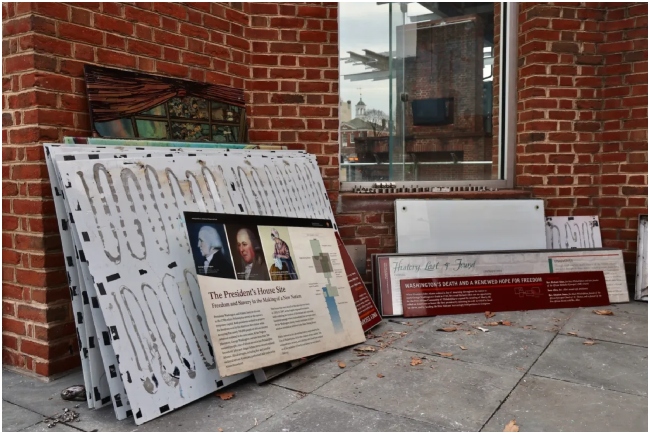
A series of interpretive signs detailing the history of enslaved people at the President’s House historic site in Old City, Philadelphia, was removed this past Thursday, provoking concern from historians, activists, and legal experts about the erasure of crucial historical narratives.
The site, which once served as the residence of Presidents George Washington and John Adams, had included information about the enslaved individuals who lived and worked there—stories that had been incorporated after years of research and public advocacy.
According to Paul Steinke, executive director of the Preservation Alliance, the removal was abrupt. “In a matter of minutes, it was all ripped down and presumably put away in storage for who knows how long,” Steinke said in a video posted to CBS Philadelphia’s Instagram account.
He called the removal “a terrible day for American history” and a setback for Independence National Historical Park and the city of Philadelphia.
Background and Controversy
When the President’s House site was originally constructed, local activists and historians urged planners to include the stories of enslaved people, arguing that a full account of American history required acknowledging slavery alongside presidential history. Those efforts succeeded, and the interpretive signage remained in place for 15 years, providing visitors with context often omitted from traditional narratives of the nation’s founding.
Steinke emphasized that the signage represented “years of scholarship and research to make sure we got the story right.” He warned that removing the materials constitutes a form of historical erasure and a failure to honor the lives and experiences of enslaved individuals:
“If we don’t commemorate it, if we don’t recognize it, we’re disrespecting the people who had to go through that terrible time, and we fought a whole Civil War over it. So it is part of our American history.”
Legal and Public Implications
The removal raises potential legal questions regarding public trust, preservation mandates, and federal oversight of historic sites. The President’s House falls under the management of the National Park Service, a federal agency tasked with protecting historical resources. Activists have previously sent letters to the Secretary of the Interior, urging that the interpretive materials remain in place to ensure that the narratives of enslaved Americans are not suppressed.
Legal scholars note that while federal agencies generally have broad discretion in site management, removing historically significant interpretive material without public consultation could trigger challenges under administrative law principles and historic preservation statutes. The move is likely to prompt renewed scrutiny and calls for policy review.
Community Response
The decision has drawn sharp criticism from the local community, civil rights advocates, and historical organizations. Philadelphia residents and preservationists argue that removing the signage undermines efforts to provide inclusive historical education and silences voices that have long been marginalized.
Steinke concluded:
“Philadelphia stood up strongly against this move last year with rallies, demonstrations, and letters. Today’s removal undermines all of that advocacy and disregards the lessons that slavery, and its memorialization, teach us about our nation.”
As the materials are now reportedly in storage, questions remain about whether they will be reinstated and how the federal government plans to balance historical integrity with evolving narratives in public history.