
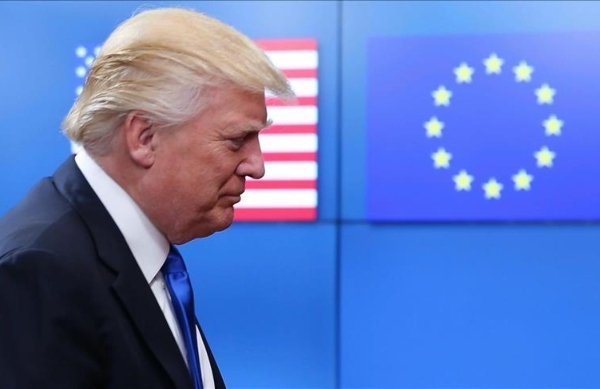
President Donald Trump’s dramatic announcement of temporary 10 percent tariffs — rising to 25 percent in June — on goods from eight European nations over the Greenland dispute has rattled diplomatic and trade circles.
The move directly targets Denmark, Norway, Sweden, France, Germany, the United Kingdom, the Netherlands and Finland, linking trade policy to Trump’s controversial demand that Denmark sell Greenland to the United States. The tariffs, set to take effect February 1, 2026, are intended to remain in place “until such time as a Deal is reached for the Complete and Total purchase of Greenland.”
The imposition of such tariffs on NATO allies and European Union (EU) members has sparked unified condemnation and prompted Europe to prepare legal and economic countermeasures. Here’s how European governments and institutions might retaliate:
🧠 1. Counter-Tariffs on U.S. Products
Europe has precedent for reciprocal trade measures following U.S. tariffs. When the U.S. previously imposed steel and aluminum tariffs, the EU responded with its own countermeasures, targeting U.S. goods such as bourbon whiskey, motorbikes, and jeans — a package worth billions of euros.
Should Trump’s Greenland-linked tariffs proceed, Brussels could similarly authorize new counter-tariffs on U.S. exports. Draft lists under prior EU measures included industrial and agricultural products worth substantial economic value.
⚖️ 2. World Trade Organization (WTO) Complaints
European officials are likely to pursue formal complaints at the World Trade Organization on grounds that Trump’s Greenland tariffs breach WTO rules prohibiting discriminatory trade measures and coercive economic diplomacy. The EU has used the WTO in past U.S.–EU disputes, including the controversial U.S. tariffs on green subsidies.
Although procedural challenges and timing can limit the speed of WTO resolutions, such actions can exert legal pressure and lay the groundwork for authorized EU retaliation if the U.S. fails to remove the tariffs.
🛡️ 3. Suspension of Trade Agreements or Negotiations
Brussels may also freeze or delay trade negotiations with Washington. The Agreement on Reciprocal, Fair, and Balanced Trade — a proposed U.S.–EU trade pact announced in August 2025 — could be sidelined or withdrawn entirely if mutual trust erodes. EU leaders have already indicated that approving such deals is untenable amid tariff threats.
🤝 4. Coordinated Diplomatic Pressure and NATO Solidarity
European heads of government have explicitly condemned the tariffs as “unacceptable” and tantamount to economic “blackmail,” reinforcing joint diplomatic resistance. Danish, French, British and Irish officials have publicly rejected Trump’s linkage of military cooperation with trade penalties.
This coordinated stance not only shapes public opinion but could also inform collective retaliation strategies under shared EU or NATO policy frameworks.
💥 5. Targeted Sector Escalation
If retaliation becomes necessary, Europe can calibrate targeted tariffs on strategic U.S. exports like technology, automotive parts, agricultural goods, and consumer products. Past EU countermeasures suspended before could be reactivated and scaled up to match or exceed the economic impact of the new U.S. levies.
⚠️ Wider Risks: Trade War and Economic Fallout
Legal experts and diplomats warn that tariff escalation could trigger a transatlantic trade war, disrupting supply chains and global markets. EU leaders emphasize that coercive tariffs undermine transatlantic relations and could lead to a “dangerous downward spiral” in cooperation.
Additionally, unilateral tariffs tied to territorial demands — such as the acquisition of Greenland — raise broader international law concerns and could prompt third-party views that both U.S. and EU trade conduct undermine global norms.
📊 Bottom Line
If Trump’s Greenland-linked tariffs remain in place, Europe is poised to respond through:
- Reciprocal tariffs on U.S. goods
- WTO legal challenges
- Delay or suspension of trade agreements
- Coordinated diplomatic pressure
- Targeted sector retaliation
Each of these steps could significantly reshape U.S.–EU trade relations in 2026 and beyond, raising the stakes not just for Washington and Brussels, but for global markets and legal norms governing international trade.