
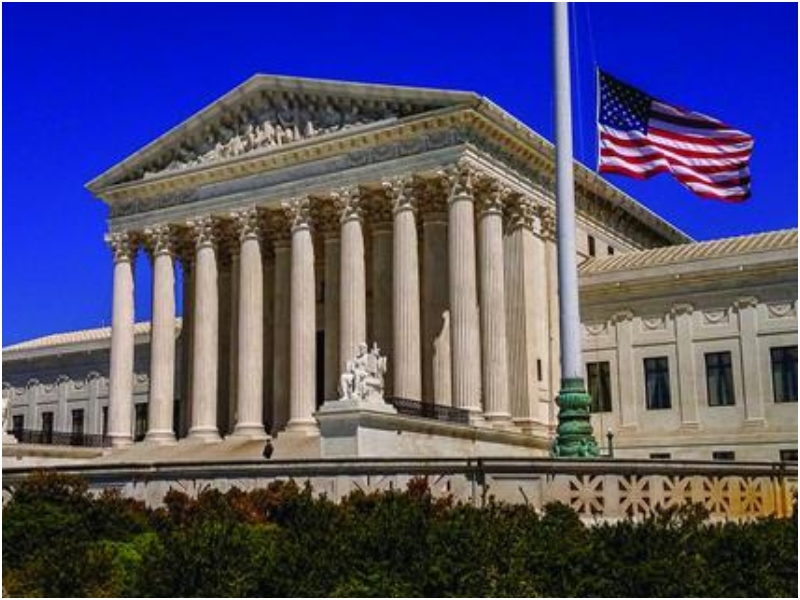
The U.S. Supreme Court’s decision to immediately finalize its ruling in Louisiana v. Callais is sending shockwaves through the legal and political landscape, with voting rights advocates warning the move could dramatically accelerate partisan redistricting efforts and weaken protections historically used to preserve Black political representation.
In a rare procedural step, the Court bypassed its standard 32-day waiting period and allowed Louisiana officials to move immediately toward drawing a new congressional map ahead of the 2026 elections. The revised map is widely expected to benefit Republicans and reduce Black voting power in the state after the Court struck down Louisiana’s 2024 map containing two majority-Black congressional districts.
For legal analysts, the implications extend far beyond Louisiana.
Why the Court’s Procedural Move Matters
Ordinarily, Supreme Court rulings are not formally sent back to lower courts for more than a month, giving parties time to seek rehearing or reconsideration. But the Court granted an emergency request from challengers to finalize the judgment immediately.
That procedural acceleration now allows Louisiana lawmakers to redraw congressional lines while election preparations are already underway.
Critics argue the significance lies not only in the underlying ruling, but in the Court’s willingness to intervene quickly in an active election cycle.
Justice Ketanji Brown Jackson, the lone dissenter, warned that the Court’s actions risked creating instability and signaling judicial approval of aggressive mid-cycle redistricting.
“This unfolds in the midst of an ongoing statewide election,” Jackson wrote, describing the situation as carrying “a strong political undercurrent.”
Legal scholars say the decision may embolden states to pursue rapid map changes after favorable court rulings, even when elections are already in progress.
Potential Weakening of Section 2 Voting Rights Protections
The case also carries broader implications for Section 2 of the Voting Rights Act, the landmark federal law prohibiting racial discrimination in voting.
Louisiana’s 2024 congressional map had been adopted after lower courts previously concluded that an earlier map with only one majority-Black district likely diluted Black voting strength in violation of Section 2.
But the Supreme Court’s 6-3 ruling invalidated that newer map, opening the door for Louisiana to potentially return to having only one majority-Black district despite Black residents making up nearly one-third of the state’s population.
Civil rights attorneys fear the decision could narrow the practical power of Section 2 by making it harder to preserve or create districts where Black voters can effectively elect candidates of their choice.
The Court did not formally eliminate Section 2 protections. However, advocates argue the ruling signals increased skepticism from the conservative majority toward race-conscious districting remedies.
A Growing Clash Over Judicial Neutrality
The unusually sharp exchange between Jackson and Justice Samuel Alito also highlighted growing tensions inside the Court itself.
Jackson accused the majority of abandoning judicial restraint and effectively stepping into a politically charged battle over congressional power.
She argued the Court could have avoided “the appearance of partiality” simply by allowing the standard waiting period to remain in place.
Alito, joined by Justices Clarence Thomas and Neil Gorsuch, sharply rejected that argument, calling Jackson’s criticism “baseless and insulting.”
The exchange underscores a deeper national debate about whether the Court is increasingly influencing election administration and redistricting outcomes in ways that appear politically consequential.
Implications for 2026 Elections and Beyond
The immediate practical effect is that Louisiana lawmakers can move quickly to redraw congressional boundaries before the 2026 midterm elections. Republicans currently hold four of Louisiana’s six House seats, but revised maps could potentially increase that advantage.
At the same time, lawsuits challenging Louisiana Gov. Jeff Landry’s postponement of congressional primaries are already moving through federal and state courts, meaning further litigation remains likely.
Beyond Louisiana, election law experts say the ruling may encourage other states to revisit district maps more aggressively, especially in jurisdictions where racial representation and partisan advantage overlap.
The Court’s refusal to later reverse its expedited order, without explanation, further reinforces that the justices are willing to use emergency procedures to influence election-timeline disputes with major political consequences.
For voting rights groups, the concern is that the combination of procedural speed, reduced judicial hesitation, and narrowed protections under the Voting Rights Act could reshape congressional representation for years to come.