
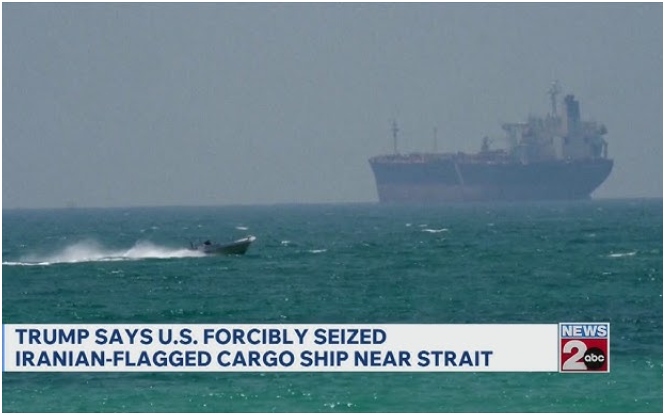
A high-stakes maritime confrontation between the United States and Iran has intensified after U.S. forces intercepted and seized an Iranian-flagged cargo vessel in the Gulf region, raising serious legal questions about the enforcement of naval blockades and alleged violations of international law.
According to statements by President Donald Trump, the U.S. Navy intercepted the vessel, identified as the Touska, after it allegedly attempted to bypass an ongoing U.S. naval blockade. Trump claimed the ship failed to comply with warnings to halt, prompting U.S. forces to disable it by “blowing a hole in the engine room” before taking control.
U.S. Central Command later released footage appearing to show a naval vessel firing toward a cargo ship during the interception.
Iran Calls Seizure “Armed Piracy”
Iranian officials swiftly condemned the operation, describing it as a breach of a fragile ceasefire and a violation of international maritime law. A spokesperson for Iran’s Khatam al-Anbiya Central Headquarters accused the U.S. of opening fire on a commercial vessel in the Sea of Oman, disabling its navigation system, and boarding it with deployed marines.
Tehran labeled the incident an “act of armed piracy” and warned of imminent retaliation.
The legal characterization of the seizure could prove pivotal. Under international law, particularly the principles governing freedom of navigation and the law of the sea, the use of force against civilian vessels outside active hostilities may constitute unlawful interference unless justified under recognized exceptions such as self-defense or UN-sanctioned enforcement actions.
Sanctions and Blockade Enforcement
President Trump asserted that the Touska was already under U.S. Treasury sanctions due to alleged prior illegal activity, framing the interception as a lawful enforcement action within the scope of the blockade.
However, legal experts note that unilateral sanctions do not automatically grant authority for forcible seizure on the high seas, especially in contested or international waterways like the Strait of Hormuz—a critical global النفط transit route through which roughly 20% of the world’s oil supply passes.
The blockade itself, announced by Washington amid escalating tensions, has not been endorsed by a United Nations Security Council resolution, raising further legal ambiguity about its enforceability under international law.
Ceasefire Tensions and Diplomatic Fallout
The seizure comes amid a tenuous ceasefire following weeks of conflict triggered by U.S. and Israeli strikes on Iran earlier this year. Iran has argued that the blockade—and now the vessel seizure—violates the terms of that truce.
Diplomatic efforts to resolve the conflict appear increasingly uncertain. The White House confirmed that Vice President JD Vance is expected to lead a delegation for a second round of talks in Pakistan. However, Iranian state media has indicated Tehran may refuse to participate while the blockade remains in place.
Global Trade and Security Implications
The incident has further destabilized traffic through the Strait of Hormuz, where shipping activity has already declined sharply amid rising security risks. Several recent reports indicate vessels have been fired upon or forced to reroute, compounding concerns for global energy markets.
From a legal standpoint, the situation underscores the complex intersection of maritime law, armed conflict, and economic sanctions. Key issues likely to emerge include:
- Whether the U.S. blockade constitutes a lawful act under international law
- The legality of using force to enforce sanctions against commercial vessels
- Potential violations of the ceasefire agreement
- Liability for damages to the seized vessel and its cargo
Escalation Risks
President Trump has maintained a hardline stance, warning that failure to reach a deal could lead to further military action against Iran’s infrastructure. Meanwhile, Iran’s threat of retaliation raises the risk of renewed hostilities in one of the world’s most strategically vital waterways.
As the situation unfolds, legal analysts and international observers are closely watching whether this incident triggers formal disputes in international forums or escalates into broader conflict.