
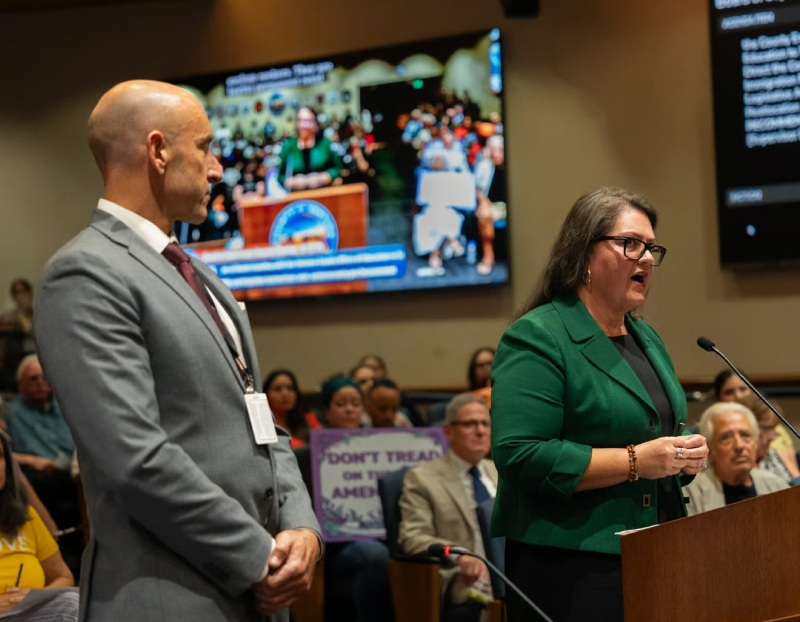
Los Angeles County has taken a historic step that could reshape the landscape of immigration justice in the United States. For the first time in its 111-year history, the LA County Public Defender’s Office will represent immigrants in federal deportation proceedings — a legal arena where millions have been forced to stand alone.
The move establishes a new removal-defense unit staffed with in-house immigration attorneys who will screen individuals, provide guidance and referrals, and offer full legal representation to those who qualify.
It marks a major break from long-standing U.S. legal tradition: public defenders typically handle only criminal cases because the Sixth Amendment guarantees counsel only in criminal proceedings, leaving immigrants in civil immigration court to navigate life-altering cases without government-appointed attorneys.
For communities long caught between the criminal and immigration systems, the shift could be transformative.
A System Built to Fail the Vulnerable
The stakes were made painfully clear by Giselle, an LA resident whose friend was arrested after giving a ride to someone carrying an open container — a charge dismissed within hours. Yet she never made it home.
“ICE was waiting,” Giselle said. By the time charges were dropped, her friend had already been taken into federal custody and deported to Mexico, shattering a family that remains in California.
Stories like this have been common in LA County, where thousands of immigrants have been detained even after completing their criminal cases. Between 2010 and 2014 alone, more than 18,500 people were held past their release dates due to ICE detainers — hold requests that kept immigrants in jail without warrants or probable cause.
That system collapsed under the weight of Roy v. County of Los Angeles, a major lawsuit that exposed the county’s unconstitutional practice of holding individuals solely because ICE asked. The settlement forced policy changes, provided $14 million in compensation — and left behind unclaimed funds.
Those leftover cy pres funds now finance the new removal-defense unit.
A Long Road to Reform
Assistant Public Defender Graciela Martinez, a driving force behind the Roy litigation and now a pioneer in “crimmigration” practice, says the new office is about more than legal defense.
“This is about looking at people as individuals — not criminals, not monsters,” she said.
The new team will not only represent clients in immigration court but also guide and educate those who do not meet eligibility criteria. The office is exploring whether some funds may also support immigration bond payments for individuals detained in ICE facilities.
But LA’s breakthrough also throws the state’s uneven legal protections into sharper relief. California’s 58 counties operate independently, and many — especially in conservative regions — remain unwilling to invest in immigration defense. Ventura County, home to more than 100,000 daily commuters to LA, recently declined to expand its legal-defense program, leaving cities like Oxnard to step in with their own funding.
Statewide data shows the need is overwhelming. Of the more than 450,000 people ordered removed over the past year, roughly three out of four had no lawyer. Even in California — often seen as a national leader in immigrant rights — funding gaps leave thousands unrepresented each year.
A Turning Point, Not a Cure
Immigrant families say the crisis is far from solved.
“Our biggest crime is being brown,” said Giselle, who fears federal retaliation. Her friend Jessica added that racial profiling shapes everyday decisions, including who in her family must take on additional work to reduce the risk of being targeted.
“I’m light-skinned,” she said. “They think I’m not Mexican, but I am.”
Legal experts believe LA’s new unit could become a national blueprint.
“This is a critical moment,” said UCLA professor Ingrid Eagly. “Immigrants are being arrested every day by federal agents who show up in masks, without warrants, engaging in racial profiling.”
The creation of the unit won’t mend every fracture in the system. But it represents an unprecedented acknowledgment: the divide between criminal justice and immigration enforcement has become too intertwined — and too consequential — to ignore.
For the first time, one of America’s largest public defender offices is stepping directly into the deportation courts that have long operated in the shadows, giving some of the system’s most vulnerable people something they’ve rarely had — a fighting chance.