
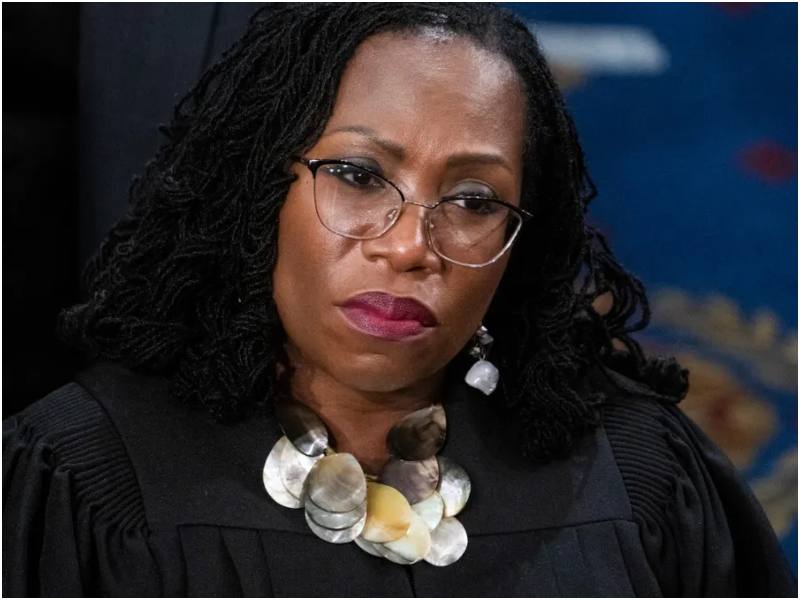
In a 6,323-word concurring opinion, Justice Jackson dismantles the Thomas dissent’s narrow reading of the 14th Amendment, calling it a “return” to the infamous 1857 decision’s “core tenet.”
Justice Ketanji Brown Jackson, joined in part by Justice Sonia Sotomayor, filed a sharp concurring opinion on Tuesday in Trump v. Barbara, accusing Justice Clarence Thomas of advancing a “myopic” and “ahistorical” interpretation of the 14th Amendment’s Citizenship Clause that contradicts both the historical record and Thomas’s own longstanding “colorblind” constitutional doctrine.
The case, decided 6-3, struck down President Donald Trump’s Executive Order No. 14160, which sought to deny automatic citizenship to children born in the United States to parents who are undocumented or temporarily present. Chief Justice John Roberts authored the majority opinion, joined by Justices Sotomayor, Elena Kagan, Amy Coney Barrett, and Jackson. Justice Brett Kavanaugh filed an opinion concurring in the judgment. Justices Thomas, Samuel Alito, and Neil Gorsuch dissented.
The Thomas Dissent: A “Domicile” Requirement
Thomas’s 91-page dissent argued that the Citizenship Clause was a narrow race-conscious remedial measure intended only to secure citizenship for formerly enslaved Black Americans and those who, as he put it, “had no other homeland, owed no allegiance to any foreign power, and were subject to no other authority”. He contended that the Clause requires not just birth on U.S. soil but also “domicile”—a concept he defined as both physical presence and permanent allegiance to the country. Children of foreign temporary visitors, Thomas argued, do not qualify because they remain tied to another sovereign and are not fully “subject to the jurisdiction” of the United States in the constitutional sense.
Thomas invoked Black history to support his position, writing that “Blacks were entitled to citizenship because they were Americans”. He argued that the Reconstruction Congress overruled Dred Scott “first with the Civil Rights Act of 1866, then with the Citizenship Clause of the Fourteenth Amendment,” and that both guaranteed citizenship only to “persons born and domiciled in the United States regardless of their race”. “Neither guaranteed citizenship to persons who were not domiciled in the United States,” he wrote.
Jackson’s Response: Universalism, Not a “Spot Treatment”
Jackson’s concurrence—nearly as long as the majority opinion at 6,323 words—systematically dismantled Thomas’s reading. “Despite his longstanding endorsement of a ‘colorblind’ Constitution, Justice Thomas now surprisingly suggests that the Citizenship Clause was a race-conscious remedial measure, relating only to ‘freed slaves such as Dred Scott,’” she wrote.
Jackson emphasized that the Reconstruction Amendments were not a “mere spot treatment for the dark stain of slavery” but rather an “anticaste, antisubordination reset for the Nation.” She walked through the historical record, citing the activism of Black Americans who organized hundreds of conventions in the decades before the 14th Amendment’s ratification. These delegates, she noted, did not argue for a unique set of rules catering only to their situation—they “drew upon the moral and political force of the universal principles that were already core to the Nation’s identity.”
Jackson also cited the legislative history of the Civil Rights Act of 1866, the precursor to the Citizenship Clause. While the initial proposal focused narrowly on “persons of African descent,” Senator Lyman Trumbull withdrew it and offered a universalist replacement: “All persons born in the United States, and not subject to any foreign power, are hereby declared to be citizens of the United States, without any distinction of color.” During the ratification debates, she noted, senators explicitly rejected attempts to exclude Chinese and Romani children from birthright citizenship. “No Senator rose to agree with Senator Cowan or dispute what Senator Conness had said,” Jackson wrote. “And no Senator said what the principal dissent says today.”
‘A Return to Dred Scott’s Core Tenet’
Jackson’s most pointed accusation was that Thomas’s reading echoed the infamous 1857 decision in Dred Scott v. Sandford. “Of course, the ultimate irony is that for all the talk about the detestable Dred Scott decision, the Government and [Thomas] propose a return to its core tenet,” she wrote. “Their bottom line is that, for certain people, being born on American soil will not suffice to confer citizenship”.
Jackson further criticized Thomas’s framing for pitting Black Americans against immigrants. “Freed Blacks fought for the shared humanity of all people,” she wrote. “And the Great Emancipator eventually foresaw that the only path forward that could prevent a return—in any form—to slavery and race-based subordination was to link the fates of all”. She cited Frederick Douglass, who had called for a home “not only for the negro, the mulatto and the Latin races, but I want the Asiatic to find a home here in the United States.”
The Majority’s Holding
Chief Justice Roberts’s majority opinion reaffirmed the more than 100-year-old understanding that nearly all people born in the United States are citizens. “Citizenship, then and now, was the right to have rights—to freely participate in our political community,” Roberts wrote. “The Framers of the Fourteenth Amendment extended that promise to ‘every free-born person in this land.’ We keep that promise today”.
The Court held that children born in the United States to parents unlawfully or temporarily present are “subject to the jurisdiction” of the United States and are citizens at birth under the Citizenship Clause. The majority observed that the Fourteenth Amendment mirrored the English common law’s criteria for citizenship, starting with territory and ending with sovereign power.
Impact and Implications
The decision invalidates a second of Trump’s signature initiatives from his second term. The executive order, which never took effect after being blocked by every federal court that examined it, would have denied citizenship to an estimated 250,000 babies born in the U.S. each year, according to the Migration Policy Institute and Penn State’s Population Research Institute.
The sharply divided opinions reflect three divergent accounts of the Constitution. As one analysis noted, “The Roberts majority treated birth in the United States, coupled with subjection to U.S. sovereign authority, as enough to establish citizenship under the 14th Amendment. The principal dissents focused on a more demanding concept of allegiance”. Justice Kavanaugh’s middle position would have sided with the challengers but avoided the majority’s broader constitutional holding.
The Jackson-Thomas Dynamic
The exchange marks the latest chapter in an ongoing ideological rivalry between the Court’s two Black justices. In 2023, Thomas’s “colorblind Constitution” view prevailed when the Court struck down race-conscious university admissions programs—a decision Jackson sharply dissented from. Now, Jackson has turned Thomas’s own rhetoric against him. “The Court’s conception of a color-blind Constitution and the Government’s (and principal dissent’s) cramped, group-specific reading of the Citizenship Clause are two sides of the same coin,” she wrote, “stemming from a basic misunderstanding of the relevant history.”
Thomas did not reference Jackson’s concurrence in his dissent. But Jackson had the final word: “Our Nation did not undergo something as profound and world-shifting as ‘Reconstruction’ for naught. The question is (and always has been): Does the affected individual or group enjoy equal dignity? And the correct answer is (and has always been) to heed the Fourteenth Amendment’s universalist, antisubordination command.”
The Case: Trump v. Barbara, No. 25-365 (U.S. June 30, 2026)