
A renewed redistricting effort in Tennessee is drawing sharp legal scrutiny as lawmakers consider changes that critics argue would dismantle the state’s only Black-majority congressional district, raising significant questions under federal voting rights law and constitutional protections.
At the center of the controversy is a proposal that could transform Tennessee’s current 8–1 Republican congressional split into a 9–0 delegation. Opponents contend the move would dilute minority voting strength and invite litigation under the Voting Rights Act and the Equal Protection Clause of the Fourteenth Amendment.
Lawmakers Signal Potential Legal Challenge
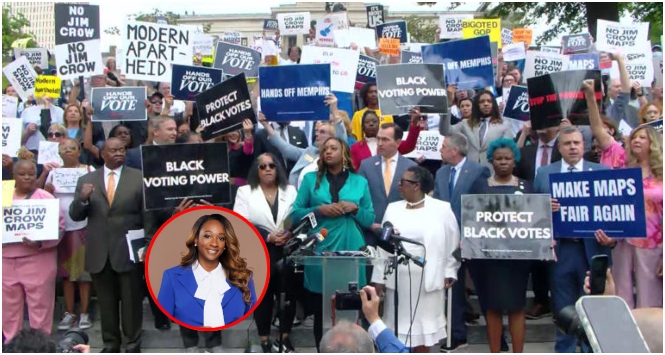
Speaking at a rally in Memphis, London Lamar framed the proposed redistricting as a direct affront to voting rights protections.
“They are going to take our vote away in front of everybody,” Lamar said, warning that the plan could effectively eliminate meaningful representation for Black voters in the state.
Her remarks come amid heightened legal uncertainty following recent federal court decisions that have narrowed the scope of claims available under Section 2 of the Voting Rights Act, particularly regarding challenges to district maps based on discriminatory effects rather than explicit intent.
Section 2 and Minority Vote Dilution
Legal experts note that any challenge to Tennessee’s proposed map would likely hinge on Section 2 of the Voting Rights Act, which prohibits voting practices that result in minority voters having “less opportunity” to elect representatives of their choice.
Historically, plaintiffs have relied on the framework established in Thornburg v. Gingles to prove vote dilution. However, recent judicial interpretations have complicated enforcement, particularly in cases involving the dismantling of existing majority-minority districts.
If enacted, the Tennessee plan could test whether courts are still willing to intervene where a previously effective minority district is eliminated.
Partisan Gerrymandering vs. Racial Gerrymandering
The dispute also underscores the legal distinction between Partisan Gerrymandering—which the U.S. Supreme Court has deemed largely nonjusticiable—and racial gerrymandering, which remains subject to constitutional challenge.
Opponents argue that while the proposal may be framed as partisan, its practical effect could disproportionately impact Black voters, opening the door to claims of unconstitutional racial discrimination.
The involvement of Memphis, home to a significant portion of the state’s Black population, further heightens the legal stakes.
Political Context and Congressional Impact
The current district is represented by Steve Cohen, a Democrat whose seat could be effectively neutralized under the proposed map.
Critics argue that the inability to defeat an incumbent through electoral means does not justify redrawing district lines in a way that alters the composition of the electorate.
“They’re not good enough to win at the ballot box,” Lamar said, suggesting the move is politically motivated.
Anticipated Litigation and Next Steps
Should the redistricting plan advance, legal challenges are widely expected from civil rights organizations and affected voters. Potential claims could include:
- Violations of Section 2 of the Voting Rights Act
- Equal Protection claims under the Fourteenth Amendment
- Allegations of intentional racial discrimination in map design
Courts would likely examine demographic data, legislative intent, and the practical impact on minority voters in determining whether the map withstands judicial review.
Broader Implications
The Tennessee case could become a bellwether for post-2025 redistricting litigation nationwide, particularly as states navigate a shifting legal landscape with fewer federal constraints.
For now, advocates continue to mobilize under the rallying cry heard across Memphis: “Hands Off Memphis,” signaling that the fight over representation is likely headed from the streets to the courts.