
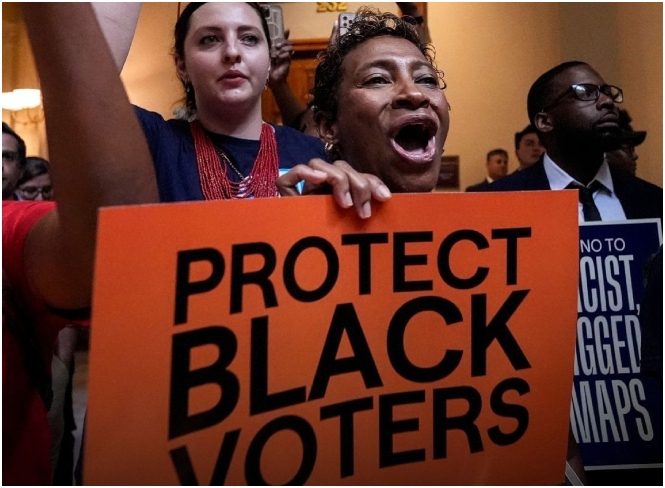
Georgia lawmakers may have stopped a proposed redistricting effort for now, but legal and political observers say the larger battle over voting maps in the state is far from over.
Republican legislative leaders on Wednesday rejected an effort backed by Gov. Brian Kemp to redraw Georgia’s congressional and legislative districts ahead of the 2028 election cycle, halting what could have become one of the earliest state-level tests of the U.S. Supreme Court’s recent redistricting decision.
For many voters, the immediate question now is straightforward: What happens next?
The short answer: Georgia’s current district maps remain in place for now, but lawmakers left the door open for another attempt later this year.
State House Speaker Jon Burns said legislators need more time to understand the legal implications of the Supreme Court’s ruling in Louisiana v. Callais and the impact of ongoing lawsuits involving Georgia’s existing districts.
That means no immediate changes to congressional or legislative boundaries.
But the pause should not be mistaken for the end of the issue.
What lawmakers could do next
Several developments are likely to shape what happens in coming months:
- Republican lawmakers could revisit redistricting during a later special or regular legislative session.
- Courts could issue rulings affecting existing Georgia maps.
- Legislators may wait for more legal interpretation of how race can be considered in drawing districts after the Supreme Court’s decision.
- Political calculations for the 2028 election cycle may influence whether lawmakers return to the issue.
Privately, some Republicans reportedly worried that moving too quickly could trigger political backlash or unintentionally create more competitive districts around metro Atlanta.
Why the Supreme Court decision matters
The debate centers on the Supreme Court’s decision in Louisiana v. Callais, which changed how states may approach district boundaries involving race.
For decades, Section 2 of the Voting Rights Act of 1965 was widely understood to require districts that gave historically marginalized racial groups a meaningful opportunity to elect candidates of their choice.
Supporters argued such districts protected minority representation.
Critics argued race had become too prominent a factor in mapmaking.
The Supreme Court’s conservative majority concluded that drawing districts primarily with racial considerations could violate constitutional equal-protection principles.
That decision immediately sparked concern among voting-rights organizations and civil-rights advocates who argue race and political affiliation are deeply intertwined in Southern states, making “race-neutral” map drawing difficult in practice.
What it means for Georgia voters
For everyday voters, nothing changes immediately:
- Existing congressional districts stay in effect.
- Current state legislative boundaries remain unchanged.
- No new maps will affect upcoming elections at this time.
However, the issue could become particularly important because Georgia’s next secretary of state and state election officials will eventually oversee elections using whatever maps emerge for 2028 and beyond.
Civil-rights groups have already indicated they intend to remain engaged if redistricting returns to the legislative agenda.
U.S. Sen. Raphael Warnock and other opponents argued that altering minority representation could have long-term consequences for voting access and political power.
The political fight may have paused at the Capitol, but legally and electorally, Georgia’s map battle appears to be entering its next phase rather than ending.