
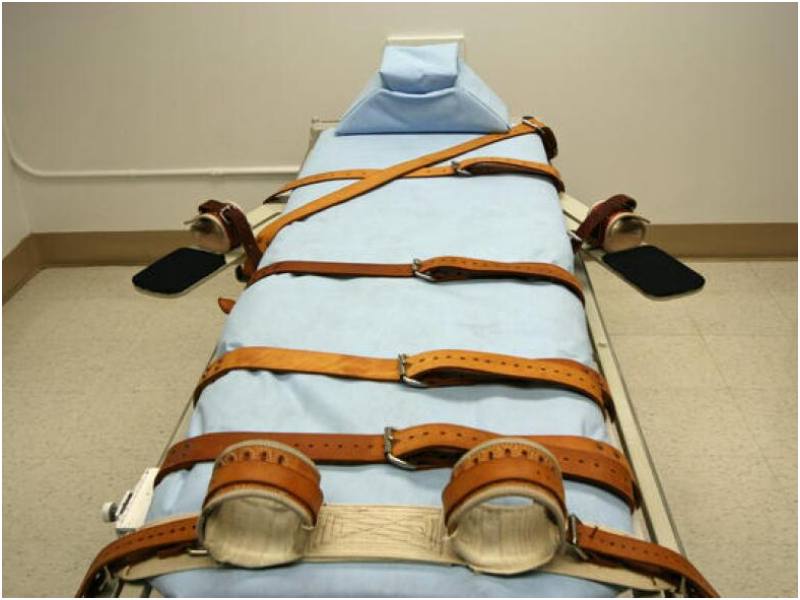
Alabama has asked the U.S. Supreme Court to intervene in a high-stakes death penalty dispute, seeking permission to carry out the execution of death row inmate Jeffery Lee using nitrogen hypoxia despite lower court rulings that found the method likely violates the Constitution.
The emergency request, filed Thursday morning, June 11, 2026, comes just hours before Lee’s scheduled execution and marks the latest legal challenge involving Alabama’s controversial use of nitrogen gas as an execution method.
Lee was sentenced to death for the 1998 robbery and murder of a pawn shop owner and employee. However, his execution has become the center of a broader constitutional battle over whether nitrogen hypoxia—a method that causes death by replacing oxygen with nitrogen—subjects inmates to cruel and unusual punishment in violation of the Eighth Amendment.
Under Alabama’s protocol, a mask is placed over the inmate’s face and nitrogen gas is administered until oxygen deprivation causes unconsciousness and death.
The dispute escalated this week when the U.S. Court of Appeals for the 11th Circuit concluded that nitrogen hypoxia presents a substantial risk of serious harm. Citing findings from the district court, the appellate court determined that the method could subject prisoners to one to three minutes of “severe air hunger” accompanied by emotional distress, anxiety, physiological stress, and physical discomfort before losing consciousness.
The court found that such suffering exceeds the mental anguish typically associated with a pending execution and ordered further review of the case.
One day later, U.S. District Judge Emily Marks issued a permanent injunction barring Alabama from executing Lee using nitrogen hypoxia. Marks determined that a firing squad—an alternative method proposed by Lee—would likely result in a painless death and therefore represented a safer constitutional alternative.
The ruling marked a significant setback for Alabama, which has been a national leader in adopting nitrogen hypoxia as an alternative execution method.
In its filing to the Supreme Court, Alabama argues that the lower courts have dramatically expanded Eighth Amendment protections beyond established legal precedent.
State Solicitor General A. Barrett Bowdre contended that any breathing discomfort associated with nitrogen hypoxia does not rise to the level of severe pain prohibited by the Constitution. The state further argued that executions inherently involve some degree of discomfort and that the courts improperly relied on emotional distress as a basis for finding the method unconstitutional.
Bowdre warned that allowing the lower court rulings to stand could result in the first judicially imposed permanent ban on a legislatively authorized execution method in American history.
The state also challenged the lower court’s acceptance of a firing squad as a viable alternative, arguing that Alabama lacks an established firing squad protocol and that implementing one would require substantial time and resources.
Under Supreme Court precedent, inmates challenging an execution method generally must identify a feasible and readily available alternative. Alabama maintains that Lee has failed to meet that requirement because a firing squad is not currently authorized or operational within the state.
Legal scholars, however, argue that the state’s request faces significant procedural hurdles.
In a friend-of-the-court brief filed with the justices, Georgetown University law professor Stephen Vladeck urged the Supreme Court to reject Alabama’s application. Vladeck argued that the state is effectively seeking to overturn a final judgment on the merits rather than requesting temporary emergency relief.
According to Vladeck, such a request should be treated as a petition for Supreme Court review and therefore subjected to a far more demanding legal standard than Alabama has invoked.
The case arrives as courts across the country continue to confront challenges to execution protocols and the constitutional limits of capital punishment. The Supreme Court’s response could have implications not only for Lee’s scheduled execution but also for future litigation involving nitrogen hypoxia and other emerging execution methods.
If the justices grant Alabama’s request, Lee’s execution could proceed despite the lower court injunction. If they decline to intervene, the state may be forced to explore alternative execution methods or pursue additional litigation before carrying out the death sentence.
The case highlights the continuing legal debate over whether newer execution methods satisfy constitutional requirements and how courts should weigh claims of physical and psychological suffering in death penalty cases.