
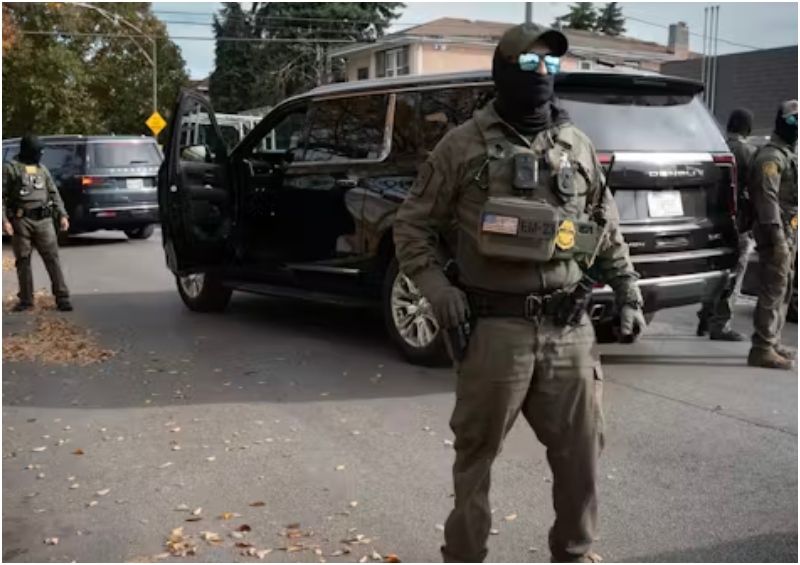
CLEVELAND, OH — A group of House Democrats, led by James “Chuy” Garcia and joined by Shontel Brown, has formally called on the White House to immediately withdraw U.S. Immigration and Customs Enforcement (ICE) agents from airports nationwide, raising concerns over legality, transparency, and administrative authority.
In a letter addressed to Department of Homeland Security (DHS) Secretary Mullin, Acting ICE Director Todd Lyons, and White House Border Czar Tom Homan, lawmakers characterized the deployment as “unprecedented and unnecessary,” arguing it undermines established federal agency functions and raises potential constitutional and administrative law issues.
The lawmakers contend that the decision by the Trump Administration to station armed ICE agents in airports exceeds traditional enforcement boundaries and lacks statutory clarity. ICE, a component of the Department of Homeland Security, is not authorized to conduct passenger screening or manage airport security operations—functions reserved for the Transportation Security Administration.
Congresswoman Brown sharply criticized the move, stating that the deployment introduces legal ambiguity and operational risk.
“This is not how federal agencies are supposed to function,” Brown said, emphasizing the absence of transparency and defined purpose. She further argued that the policy may expose the federal government to legal challenges related to due process and misuse of enforcement authority.
Legal and Oversight Concerns
The letter raises a series of oversight questions that reflect broader administrative law concerns, including whether the executive branch adhered to interagency coordination requirements and whether the deployment complies with statutory mandates governing ICE’s jurisdiction.
Lawmakers requested detailed disclosures by April 10, 2026, including the scope of deployment, operational planning, and any interagency memoranda authorizing the action.
Of particular legal significance is the request for documentation بشأن information-sharing practices between TSA and ICE. Lawmakers are seeking policies or memoranda that may authorize the transfer of traveler data for immigration enforcement purposes—an issue that could implicate privacy law, Fourth Amendment protections, and federal data governance standards.
Potential Constitutional Implications
The lawmakers’ objections also frame the deployment as a potential coercive tactic aimed at influencing congressional action, specifically in relation to funding for DHS components and proposed legislation such as the SAVE America Act. If substantiated, such claims could raise separation-of-powers concerns by suggesting executive overreach into legislative prerogatives.
Additionally, the letter references reported enforcement actions at airports, including the detention of a mother and child at San Francisco International Airport, as evidence of the potential for civil rights violations. These incidents may invite judicial scrutiny under federal civil rights statutes and immigration law frameworks.
Policy and Legislative Context
Democrats reiterated their support for continued funding of TSA, the Federal Emergency Management Agency, and other DHS components that operate within established legal parameters. However, they criticized ongoing negotiations in which additional funding for ICE and Customs and Border Protection is tied to broader legislative demands.
The dispute highlights a growing tension between Congress and the executive branch over immigration enforcement policy, particularly regarding the limits of executive authority in deploying federal agents in civilian transportation hubs.
Next Steps
The administration has been asked to respond to eight detailed questions addressing operational scope, legal justification, and policy coordination. Absent a response, legal analysts suggest the issue could escalate into formal congressional hearings or litigation challenging the deployment’s legality.
As scrutiny intensifies, the controversy may serve as a test case for the boundaries of executive power in domestic enforcement contexts and the role of congressional oversight in safeguarding administrative accountability.