
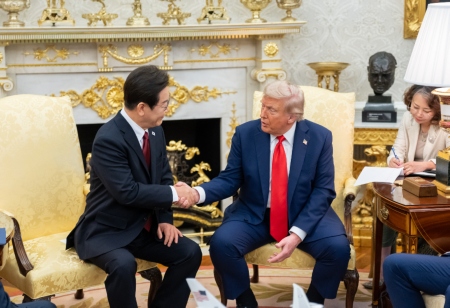
South Korea’s National Assembly has overwhelmingly passed the Special Act on Investment in the United States, authorizing a landmark US$350 billion (approximately 517 trillion won) investment package aimed at strengthening bilateral economic ties and shielding the country from renewed U.S. tariff threats.
The legislation, approved on March 20, 2026 with 226 votes in favor, eight against, and eight abstentions, establishes the Korea-U.S. Strategic Investment Corporation to execute a memorandum of understanding (MOU) signed with the United States.
The corporation will channel $150 billion into shipbuilding cooperation and $200 billion into U.S. strategic sectors including semiconductors, pharmaceuticals, critical minerals, energy, artificial intelligence, and quantum computing.
Funding will be sourced from returns on South Korea’s national foreign exchange reserves (managed by the Bank of Korea) and international bond issuances guaranteed by the Korean government. The entity is authorized to provide up to $20 billion in direct annual investments in the U.S., supplemented by loan guarantees until the full $350 billion commitment is met.
A controversial provision (Article 3, Clause 3) allows investments to proceed even when commercial viability or profitability is low, provided there are “unavoidable reasons” such as national security or supply-chain stability. Such non-commercial decisions require prior approval from the relevant National Assembly Standing Committee.
The bill’s passage follows intense pressure from U.S. President Donald Trump, who publicly urged South Korea via Truth Social to enact what he called the “Historic Trade Agreement” and threatened to reinstate “reciprocal” tariffs, raising them from 15% to 25%. The legislation is widely seen as a preemptive move to de-escalate trade tensions and secure preferential treatment for South Korean exports.
National Assembly Speaker Woo Won-sik described the outcome as “a meaningful opportunity to strengthen cooperation between the two countries and alleviate tariff customs risks.”
The investment push comes amid broader U.S. trade scrutiny. The United States recently launched an Article 301 investigation into 16 jurisdictions — including South Korea, China, Japan, and the European Union — following a U.S. Supreme Court ruling that invalidated previous tariff implementations under the International Emergency Economic Powers Act (IEEPA).
In a related development, South Korean Prime Minister Kim Min-seok met President Trump at the White House, where discussions reportedly touched on resuming diplomacy with North Korea. Speculation has grown that Trump may seek direct talks with Kim Jong-un during a planned visit to China in late March or early April 2026.
South Korea’s move reflects a high-stakes balancing act: substantial financial commitment to U.S. priorities in exchange for potential tariff relief and continued access to the American market.