
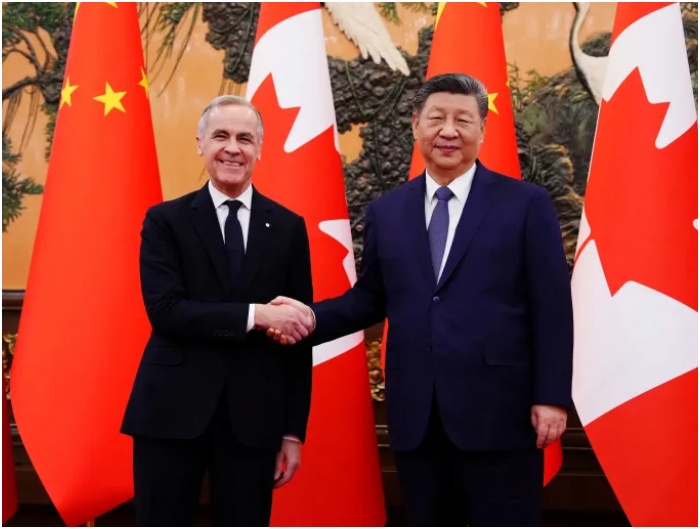
Canada has agreed to sharply reduce its tariffs on Chinese electric vehicles as part of a broader trade reset with Beijing, marking a significant legal and economic shift away from the United States’ hardline trade stance toward China.
Prime Minister Mark Carney announced Friday that Canada will lower its 100% tariff on Chinese-made electric vehicles to 6.1%, subject to an annual import cap.
Under the agreement, Canada will allow up to 49,000 Chinese EVs per year at the reduced rate, with the cap rising to about 70,000 vehicles over five years. In return, China will cut its tariff on Canadian canola seeds — a cornerstone of Canada’s agricultural exports — from 84% to roughly 15%.
The agreement follows two days of high-level meetings between Carney and senior Chinese officials, including President Xi Jinping, and comes amid prolonged trade friction between Ottawa and Washington.
“Our relationship has progressed in recent months with China. It is more predictable and you see results coming from that,” Carney said at a press conference in Beijing.
Legal and trade implications
From a legal standpoint, the move represents a recalibration of Canada’s trade remedies policy, which had previously mirrored U.S. protectionist measures. Under former Prime Minister Justin Trudeau, Canada imposed 100% tariffs on Chinese EVs and 25% duties on Chinese steel and aluminum, aligning closely with U.S. actions justified on national security and unfair trade grounds.
China retaliated by imposing steep countermeasures, including 100% tariffs on Canadian canola oil and meal, 25% tariffs on pork and seafood, and additional duties on canola seeds, effectively shutting Canadian producers out of the Chinese market. Chinese trade data show imports from Canada fell 10.4% last year to $41.7 billion.
Carney’s agreement signals a shift toward negotiated, sector-specific tariff relief rather than broad-based trade barriers, a move that may test Canada’s obligations and leverage under existing trade frameworks, including the United States-Mexico-Canada Agreement (USMCA).
U.S. Trade Representative Jamieson Greer criticized the decision, calling Canada’s willingness to allow Chinese EV imports at low tariffs “problematic” and warning that Ottawa could “regret that in the long term.”
Reaction from Washington and Beijing
U.S. President Donald Trump, who has previously threatened sweeping tariffs on Canadian goods and suggested Canada should become the “51st state,” offered measured approval of the deal.
“Well, it’s OK. That’s what he should be doing and it’s a good thing for him to sign a trade deal,” Trump said. “If you can get a deal with China, you should do that.”
Earlier Friday, Carney and Xi pledged to stabilize and improve bilateral relations after years of diplomatic strain. Xi told Carney he was willing to continue rebuilding cooperation, noting that talks had resumed following an initial meeting between the two leaders last October in South Korea.
Carney, the first Canadian prime minister to visit China in eight years, said improved relations could help shore up a global governance system he described as “under great strain,” increasingly replaced by bilateral and regional trade arrangements.
Domestic concerns and investment promises
The deal has drawn criticism at home, particularly from leaders in Canada’s auto-producing regions. Ontario Premier Doug Ford warned that the agreement risks undercutting Canadian auto workers and jeopardizing access to the U.S. market.
“China now has a foothold in the Canadian market and will use it to their full advantage at the expense of Canadian workers,” Ford said in a social media post.
Carney sought to address those concerns by emphasizing that the initial EV import cap represents about 3% of Canada’s annual vehicle sales and that China is expected to invest in Canada’s auto sector within three years.
“This agreement will drive considerable Chinese investment in Canada’s auto sector, creating good careers in Canada and accelerating our progress toward a net-zero future,” Carney said.
Academic observers say the deal reflects Canada’s broader effort to diversify its trade relationships amid global uncertainty.
“Canada is diversifying its bets economically,” said Nelson Wiseman, professor emeritus at the University of Toronto. “And China is succeeding in driving a small wedge between Canada and the U.S.”
A broader strategic pivot
Carney acknowledged that Canada’s relationship with the United States remains deeper and more complex than its ties with China, but said the current era of global trade disruption requires flexibility. He has described his government’s strategy as reducing overreliance on the U.S. market while maintaining cooperation where interests align.
The prime minister is scheduled to leave China on Saturday, travel to Qatar on Sunday to promote trade and investment, and then attend the World Economic Forum in Davos next week.