
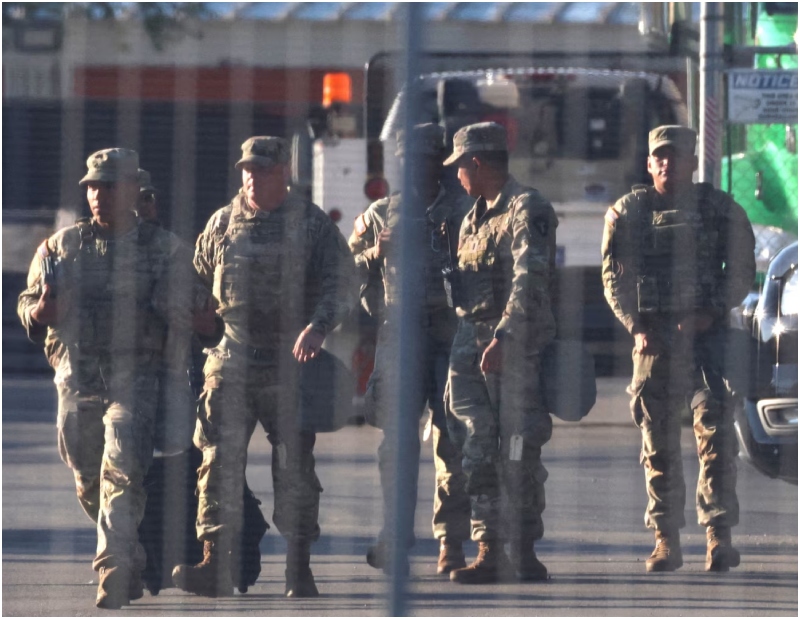
President Donald Trump has announced the removal of National Guard troops from Chicago, Los Angeles and Portland, Oregon, marking a sharp shift in the administration’s controversial domestic military deployment policy following a recent Supreme Court ruling.
In a social media post on Wednesday, Trump said the Guard would be withdrawn from the three cities, claiming crime had been “greatly reduced” due to the federal presence and warning that troops could be redeployed if crime rates rise again.
“We will come back, perhaps in a much different and stronger form, when crime begins to soar again,” Trump wrote, adding that the cities were “GONE if it weren’t for the Federal Government stepping in.”

Eric Thayer AP
Supreme Court Ruling Looms Large
Although Trump did not reference the judiciary in his announcement, the decision comes just one week after the U.S. Supreme Court allowed a lower court ruling to stand blocking the deployment of Illinois National Guard troops in Chicago.
The Court agreed with a federal judge that the administration had so far “failed to identify a source of authority that would allow the military to execute the laws in Illinois,” raising serious constitutional questions about the president’s power to federalize National Guard units for routine law enforcement purposes without state consent.
Legal analysts say the withdrawal appears to signal compliance with that ruling, not only in Chicago but also in other cities where similar deployments had been ordered.
Scope of the Deployments
According to U.S. Northern Command, approximately 300 Illinois National Guard members had been activated in Chicago and 100 Oregon Guardsmen in Portland. However, none were actively conducting operations due to the pending legal challenge.
In California, about 100 National Guard troops had been placed on a federal mission to protect Immigration and Customs Enforcement (ICE) agents.
That operation was halted on December 15, Northern Command confirmed.
Legal and Constitutional Implications
The now-paused deployments had sparked intense debate among legal scholars, civil liberties groups and state officials, who argued that the administration was stretching federal authority and undermining the traditional role of governors in controlling National Guard forces.
Under the U.S. Constitution and federal law, presidents may federalize the Guard under limited circumstances, such as insurrection or invasion. Courts have signaled skepticism that generalized crime concerns meet that threshold.
Trump’s statement suggesting a future redeployment “in a much different and stronger form” is likely to draw renewed scrutiny, particularly if the administration attempts to invoke emergency powers or alternative statutory authority.
What Comes Next
For now, the withdrawal effectively ends federal National Guard operations in the three cities, but legal experts caution that the broader constitutional question remains unresolved.
“The courts have made clear that the executive branch cannot simply use the military for domestic policing without clear legal authority,” one constitutional law professor told reporters. “Any renewed effort would face immediate legal challenges.”
As crime policy and federal-state power dynamics remain central issues heading into 2026, Trump’s decision demonstrates the growing role of the courts in defining the limits of presidential authority at home.