
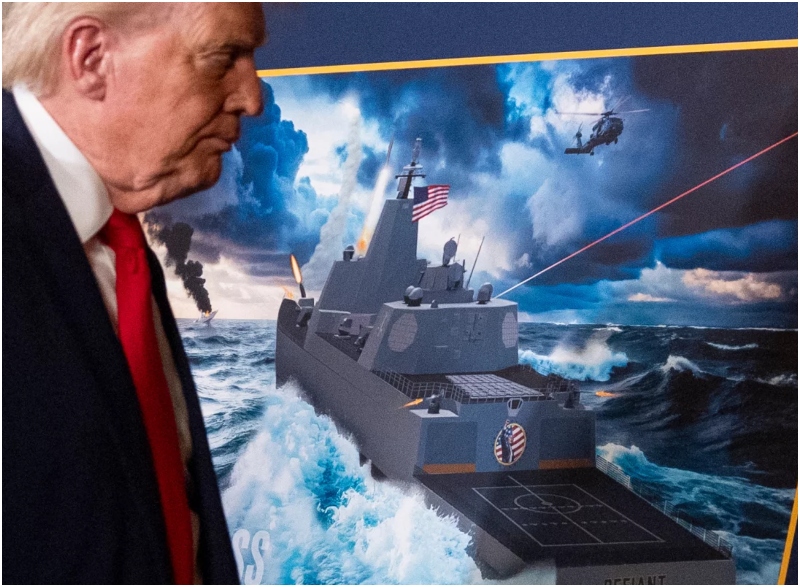
Former U.S. President Donald Trump’s announcement of a new “Trump Class” of Navy battleships has sparked renewed debate over the legal and constitutional framework governing military procurement, defence spending, and executive authority in the United States.
Speaking as commander in chief, Trump said he had approved plans for the U.S. Navy to begin constructing two massive battleships as part of what he calls the Navy’s “Golden Fleet,” with an eventual goal of building between 20 and 25 vessels.
He described the ships as the “largest ever built” and claimed they would be “100 times more powerful” than any previous battleship, equipped with hypersonic weapons, electric rail guns and high-powered lasers.
While the announcement focused heavily on military capability, legal experts note that the construction of such vessels cannot proceed on presidential approval alone. Under the U.S. Constitution, Congress holds the power of the purse, meaning any large-scale naval programme must be authorised and funded through legislation. At present, no cost estimates have been released, and neither Congress nor the Pentagon has confirmed that funds have been appropriated for the project.
The Navy has acknowledged that design studies are ongoing and that cost estimates are still being refined. Retired Navy Admiral Mark Montgomery estimated that the first ship alone could exceed US$10 billion to design, build and deploy, a figure that would require explicit congressional scrutiny and approval under federal budget and defence acquisition laws.
Legal questions have also been raised about the revival of battleships, which were phased out of U.S. service in the early 1990s. Any decision to introduce a new class would have to align with existing defence strategy documents, procurement regulations, and environmental and contracting laws that govern shipbuilding programmes. Critics argue that a shift toward massive battleships could conflict with current Navy doctrines favouring distributed fleets and smaller, networked platforms.
Trump’s suggestion that he would personally consult on the design of the ships, citing his “aesthetic” sensibilities, has further drawn attention to the limits of presidential involvement in technical military procurement. Defence acquisition rules typically place such responsibilities within the Department of Defense and the Navy, subject to oversight from Congress, inspectors general and, where disputes arise, the courts.
The president also said he plans to pressure defence contractors to prioritise factory investment over stock buybacks, a stance that could raise additional legal and regulatory issues related to corporate governance, federal contracting rules and securities law.
As the proposal stands, analysts say the “Trump Class” battleships face significant legal hurdles, from securing congressional authorisation and funding to navigating defence procurement law and strategic review processes. Until those steps are taken, the announcement remains a political declaration rather than a binding defence programme.