
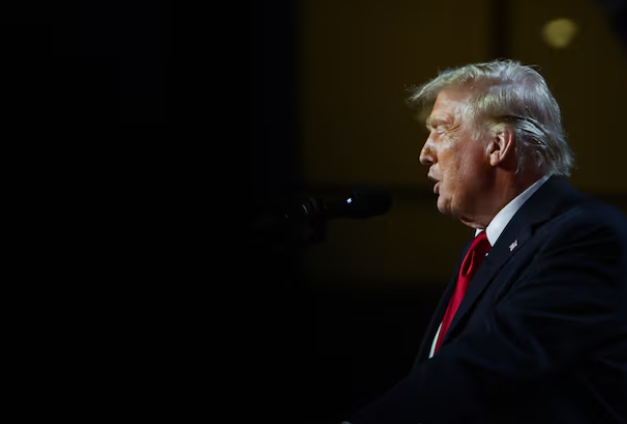
In a striking show of congressional muscle, Republicans joined Democrats this month to hand President Donald Trump one of his most significant political defeats on national security, moving decisively to block any unilateral effort to scale back U.S. military commitments to Europe and NATO.
The setback came with House passage of the National Defense Authorization Act (NDAA), a must-pass annual defense bill that cleared the chamber with a veto-proof bipartisan majority.
The legislation explicitly restricts the president from reducing U.S. troop levels in Europe below 76,000 service members without first securing approval from Congress—a direct response to Trump’s recent calls for disengagement from NATO.
The move marks a rare moment in which lawmakers from both parties reasserted Congress’s constitutional authority as a co-equal branch of government, particularly on matters of war, alliances, and troop deployments.
A Direct Check on Trump’s NATO Strategy
The congressional action followed Trump’s release of a national security strategy that argued the United States should shift its focus away from Europe and NATO, potentially pulling troops from the continent to concentrate on the Western Hemisphere.
Critics inside and outside Congress warned such a move would weaken America’s influence abroad and embolden adversaries, including Russia.
By embedding restrictions in the NDAA, lawmakers ensured that any attempt to significantly reduce U.S. forces in Europe would require legislative consent—effectively tying the president’s hands.
The bill also reaffirms U.S. commitment to NATO and includes continued, though limited, funding for Ukraine, underscoring Congress’s view that American security remains closely linked to European stability.
Bipartisan Support, Veto-Proof Majority
The House vote drew support from a broad coalition of Republicans and Democrats, signaling growing unease—even within Trump’s own party—about abandoning long-standing alliances.
Political analysts say the vote will likely be remembered as a pivotal moment in Trump’s second term, one in which Congress pushed back decisively against executive overreach on foreign policy.
Notably, Trump has remained publicly quiet on the vote, a silence that observers say reflects the scale of the defeat.
Senate Advances the Bill
Momentum continued in the Senate this week. Lawmakers voted 76–20 to clear a key procedural hurdle, moving the NDAA closer to final passage before the holiday recess. The $900 billion defense package—$8 billion more than the White House requested—includes a pay raise for service members, restrictions on U.S. investment in China, and ongoing military assistance to Ukraine.
With bipartisan backing already secured in the House, Senate leaders expect final passage in the coming days.
A Signal to Allies—and Voters
Beyond its immediate policy impact, the vote sends a strong signal to America’s NATO allies that U.S. commitments remain anchored in bipartisan consensus, even amid domestic political turbulence.
It also highlights lingering divisions within the Republican Party over Trump’s “America First” approach to foreign policy.
For voters heading into a high-stakes election year, the episode underscores a central question of Trump’s presidency: how much power the executive branch should wield over America’s global role—and where Congress is prepared to draw the line.