

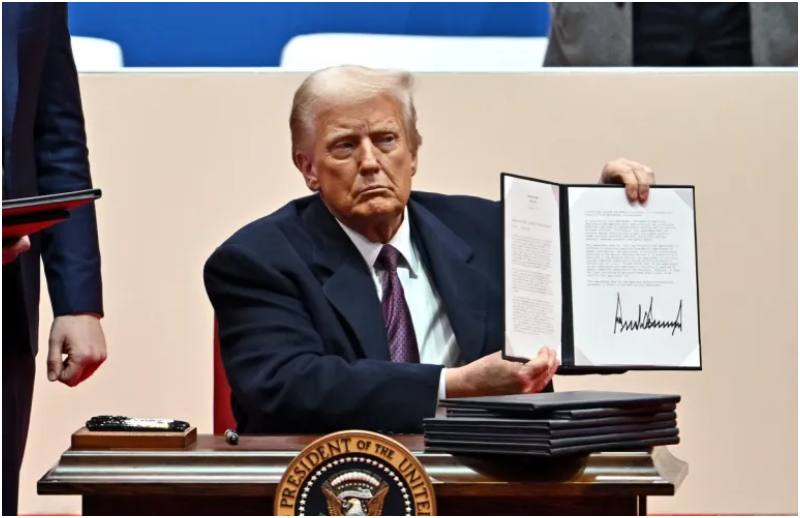
President Donald Trump confirmed Monday, December 6, 2025, that he will sign an executive order preventing individual states from regulating artificial intelligence.
Experts are concerned the sweeping move would override dozens of state-level bills aimed at curbing AI-related risks ranging from deepfakes to discriminatory algorithms.
According to a CNN report, the order, expected within days, would establish a single national AI policy crafted by the Trump administration — one designed to be “hands-off” and pro-industry.
In a Truth Social post, Trump wrote:
“There must be only One Rulebook if we are going to continue to lead in AI… We are beating ALL COUNTRIES… but that won’t last if we have 50 States, many of them bad actors, involved in RULES and the APPROVAL PROCESS.”
His announcement confirms what safety advocates, researchers and lawmakers have feared since a draft of the order leaked last month: a federal effort to wipe out state authority over AI just as the technology is accelerating into sensitive areas of American life.
A Blank Check for AI Companies?
The executive order directs the attorney general to create an AI Litigation Task Force — essentially a strike team to challenge and invalidate state AI laws, according to a draft obtained by CNN.
The draft framed the order as a competitiveness measure designed to “enhance America’s global AI dominance through a minimally burdensome, uniform national policy framework.”
But opponents say it’s a deregulatory gift to Big Tech at the exact moment the public is grappling with misinformation, privacy breaches, and disturbing reports of AI systems causing psychological harm.
“Stripping states of jurisdiction to regulate AI is a subsidy to Big Tech,” Florida Gov. Ron DeSantis said on X, calling the move “federal government overreach.”
States Have Filled the Regulatory Vacuum — Until Now
In the absence of meaningful federal legislation, states have moved aggressively. Among the issues they’ve targeted:
- Deepfake political ads
- AI-driven discrimination in hiring and housing
- Child safety and exposure to sexualized content
- Privacy violations through biometric or behavioral tracking
Under Trump’s new order, these laws would be vulnerable to federal preemption — effectively nullified.
Hundreds of groups have pushed back, including tech worker unions, civil rights groups, and consumer protection organizations.
“We’re in a fight to determine who will benefit from AI: Big Tech CEOs or the American people,” said Sacha Haworth of the Tech Oversight Project.
The White House Argument: Innovation First
National Economic Council Director Kevin Hassett defended the move Monday, telling CNBC that Trump had reviewed “something close to a final draft” of the order over the weekend.
“There are some states that want to regulate these companies within an inch of their lives,” Hassett said. “This executive order… will make it clear that there’s one set of rules for AI companies in the U.S.”
Silicon Valley executives — including OpenAI CEO Sam Altman — have lobbied the administration for a single federal standard, arguing that navigating 50 state systems could slow American innovation and undermine national security.
Congress Already Rejected a Similar Plan
In July, the Senate overwhelmingly voted to remove a federal moratorium on state AI rules from Trump’s domestic policy bill. Lawmakers from both parties argued states must retain the ability to protect their residents when Washington won’t.
Weeks later, the administration released a Silicon Valley-friendly AI action plan centered on scaling back regulation.
The executive order appears to be the next step in that campaign — even as concerns mount over AI’s real-world harms, including documented cases of:
- AI chatbots producing dangerous advice
- Systems generating sexualized images of minors
- Algorithms amplifying racial or political bias
- AI tools affecting mental health
Without state-based safeguards, critics warn, those risks could escalate unchecked.
A National Debate: Innovation vs. Accountability
The order puts the U.S. at a defining crossroads:
Should AI companies face tighter scrutiny as they deploy tools that shape how Americans work, communicate, learn and vote — or should the government minimize interference to keep the U.S. competitive?
The Trump administration has clearly chosen the latter.
What remains unclear is how voters will respond to a policy that dramatically expands federal power while potentially leaving consumers, children, and vulnerable communities less protected.
One thing is certain: The battle over who governs AI — Washington, Silicon Valley, or the states — is now fully underway.