
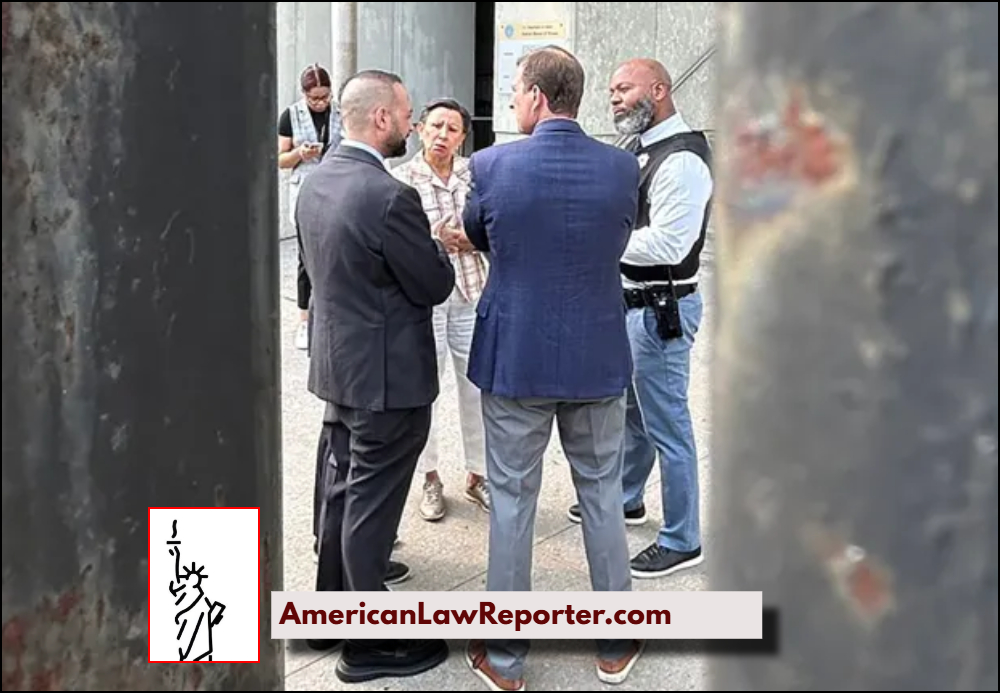
In a highly unusual and politically charged incident, three Democratic members of Congress from New York City — Rep. Adriano Espaillat, Rep. Nydia Velázquez, and Rep. Daniel Goldman — were reportedly locked behind a security fence for approximately 20–30 minutes during an attempted oversight visit to the Metropolitan Detention Center (MDC) in Brooklyn on Wednesday, August 6.
The lawmakers had sought entry to the federal facility, where according to state officials, U.S. Immigration and Customs Enforcement (ICE) is holding as many as 100 undocumented immigrants, many of whom allegedly have no criminal records. The visit, coordinated with the New York Immigration Coalition (NYIC), was aimed at inspecting detention conditions.
The NYIC released photographs showing the lawmakers walking toward the MDC, located under the shadow of the Gowanus Expressway. The coalition claimed in a statement on social media that “masked agents” had refused the legislators’ entry and subsequently “trapped them between a fence and the facility.”
According to a spokesperson for Rep. Espaillat, the facility’s gate was closed and locked before agents left the area, effectively preventing anyone from entering or exiting for the better part of half an hour.
“No one could get in or out — either way — locking the members in for that time period,” the spokesperson told Fox News Digital.
MDC’s High-Profile History
The MDC has a controversial track record, having housed high-profile inmates such as former Trump attorney Michael Cohen, MSNBC host Rev. Al Sharpton during a 2001 protest arrest, and most recently, music mogul Sean “P. Diddy” Combs and Luigi Mangione. The facility has also been the subject of federal court criticism, with one judge describing it as “contemptuous of human life and dignity.”
Ongoing Tensions Over ICE Operations
New York Democrats have long criticized ICE’s use of the MDC to hold immigration detainees, especially amid claims that many are confined without criminal charges. State Sen. Andrew Gounardes, D-Bay Ridge, said in July that the facility recently began holding over 100 detainees in conditions he called unsafe and inhumane.
“This isn’t about public safety—it’s a show of force meant to instill fear in our communities,” Gounardes said, adding that ICE’s current approach is “incredibly dangerous, disturbing, and un-American.”
Rep. Goldman, who previously served as lead counsel in the House impeachment proceedings against former President Donald Trump, criticized the federal government’s reversal of prior efforts to improve MDC staffing and reduce lockdowns. He argued that the Trump administration’s decision to house immigrants at the MDC has worsened overcrowding and strained resources.
ICE’s Stated Policy and Federal Justification
According to ICE’s Office of Congressional Relations, members of Congress are required to submit visit requests at least seven days in advance. A Department of Homeland Security (DHS) spokesperson said the policy exists to prevent “interference with the President’s Article II authority to oversee executive department functions.” The DHS also cited a reported 830% increase in assaults against ICE personnel, claiming that some incidents involved elected officials.
ICE and DHS have not publicly confirmed whether the Brooklyn lawmakers’ entry was denied for procedural reasons or as part of a security response.
Similar Incidents Nationwide
This is not the first time in recent weeks that members of Congress have been blocked from entering federal detention or processing facilities. In Newark, New Jersey, Rep. LaMonica McIver was arrested after allegedly confronting agents outside a local jail. In Baltimore, multiple lawmakers — including Reps. Kweisi Mfume, Sarah Elfreth, Johnny Olzewski Jr., and Sens. Chris Van Hollen and Angela Alsobrooks — were turned away from an ICE processing center that officials stressed was not a long-term holding facility.
With the current Trump administration constantly being criticized for its controversial decisions, the Brooklyn confrontation is likely to intensify ongoing legal and political debates over congressional oversight, executive authority, and the treatment of immigrant detainees.